The AI winter didn't help Lisp's popularity.
> The AI winter didn't help Lisp's popularity.
Really? I wouldn't have thought a symbolic machine company would have been noticeably affected by the Minsky-triggered AI winter. Or are you talking about the post Japanese Fifth Generation project slow down? The MCC project in Austin Texas (and Doug Lenat's Cyc) took some hits from that one...
A few short years after Minsky's comment, microcomputers were in full bloom and expensive Lisp machines were no longer viable. Cheap PCs could run Lisp code faster than the dedicated hardware!
But Lisp never really gained a strong foothold on microcomputers. Existing code continued to run... but development slowed down as Lisp companies went belly-up, unable to sell their hardware. The standardization of Common Lisp in 1984 did help somewhat.
The Japanese Fifth Generation project was oriented around logic-programming, was it not? I had the impression they focused on technologies like Prolog rather than Lisp.
It was a "full stack" thing. From silicon on up. And it definitely got fuzzier the higher up in the stack you went. Prolog-ish was big in the upper tiers of the stack (esp. as it had to do with "modularized knowledge" paks), but "support-all-symbolic-approaches" were motivating requirements on the lower tiers.
I lived in Japan, doing systems engineering for what are now called SOCs, before I moved to Austin during this period, and the PR around the 5th Generation Project had both the Japanese officials feeling high-on-life and the American officials a little deer-in-the-headlights panic-ey. IBM and Fujitsu (and Toshiba, and Motorola and AT&T) all made some bank off of frightened (or overly ambitious) politicos.
Symbolics and TI both developed microprocessors for Lisp in the 80s. TI promoted their Lisp chip as the 'Megachip' enabling the 'Compact Lisp Machine'. It was the first microprocessor which integrated around a million transistor functions.
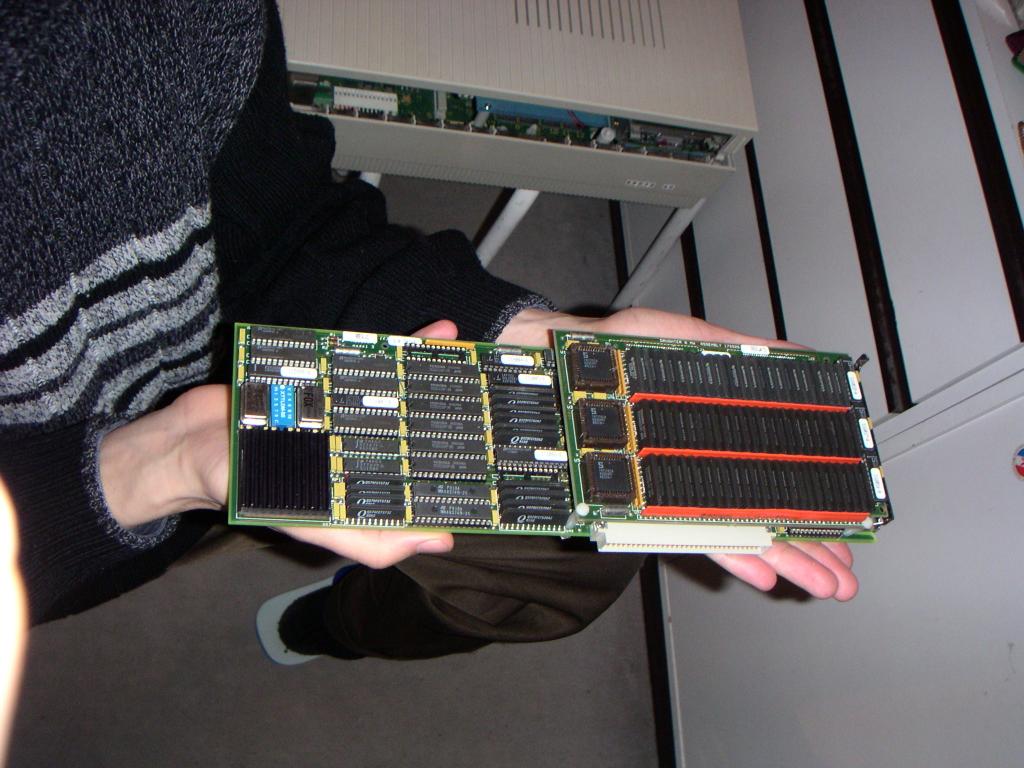
Both put the Lisp Machine for example on small Apple Nubus cards and inside an Mac II. The TI MicroExplorer and the Symbolics MacIvory were popular Lisp Machines.
This is a MacIvory board which contains a Lisp processor, a Weitek numerics chip and memory:
http://fare.tunes.org/files/pics/lispm/2003-01-19-lispm-maci...
A Mac II with a Lisp Machine inside:
https://i.imgur.com/b3XkHpS.jpg
This is a picture of two Symbolics NXP 1000 Lisp machines, which also use Lisp chip:
http://lispm.de/symbolics-nxp1000-inside/thumbnails/IMG_3044...
Basically the size of a typical pizza box machine at that time.
and now we know that at least on the NN side, what seemed like another silly toy was just a little more work and a little more hardware away from being demonstrably useful.
so anyways, I'm positing a maximum after which additional funding does active harm.