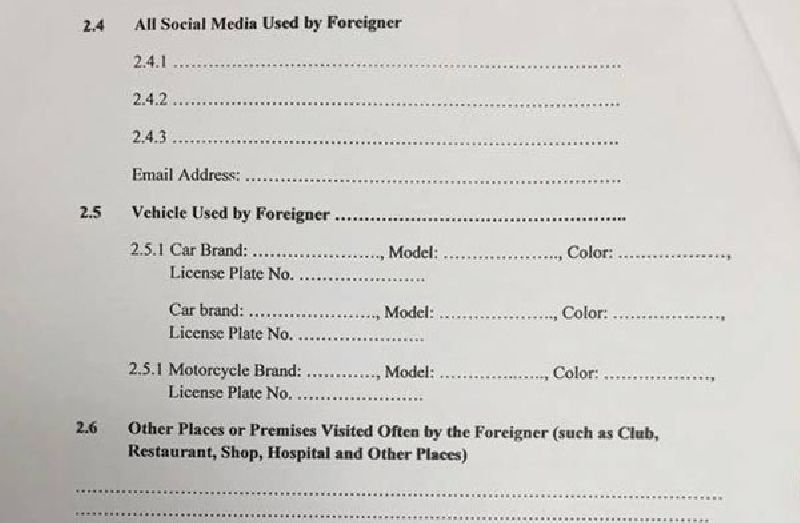
This isn't about guys with bombs causing real harm.
This is about people with different political views than the current establishment doesn't want spreading their message.
The problem is that border security is going to over interpret normal text written by normal innocent people.
If terrorists are 1-in-ten million, and the probability that you say something that has any interpretation that could be construed as terroristic is anything greater than that, then the overwhelming majority of hits are false-positives.
What I am trying to say, i guess, is someone will make money out of this, manufacturing fake twitter profiles with real looking history.
Now, the thing is, though, it's hard, because at some point your "followers" and "followings" have to be real people that interact with you ideally.
Edit: Link to the pertinent section of the form used by Thai immigration to ask for social media account information. [2].
[1] https://news.ycombinator.com/item?id=12974377
[2] http://www.khaosodenglish.com/wp-content/uploads/pre/1460977...
I have several friends who are not US citizens, so I get to hear about how much it sucks from their perspective. There are differences depending on country of origin and visa type. My friends who are from "bad" immigration countries like India, China, and Russia have a hard time, but friends who are from more "trusted" countries tend to have it much easier. My friends who are on long term / work visas find it a huge pain to deal with renewal and keeping it updated (and sometimes my friends from "bad" countries get stuck outside the US for weeks during renewal, for no good reason), but the actual border crossings aren't too bad, as long as they have all their paperwork in order. I don't really know anyone who visits the US on a tourist visa or similar, so I don't know what that experience is like.
Regarding changes for non-citizens, despite my friends relating their experiences, I don't think I've seen _that_ much of a negative difference over the past few years. The onerous fingerprinting requirements are not new[1], and the idea of the anxiety-inducing chat with the immigration officer is even older and doesn't seem to have changed much post-9/11. The new social media stuff is of course ridiculous, especially if it morphs into a hard requirement (or worse, a soft one, where refusing to provide details habitually results in denied entry). Is there a timeline anywhere of changes to US entry practices in the last decade or two? It'd be interesting to see if there have been a lot of small, incremental, "unnoticeable" changes.
[1] And it seems many other countries have adopted fingerprinting requirements anyway; I was just in Japan and Taiwan, and both fingerprinted me. I believe Japan has been requiring fingerprints of visitors longer than the US has.
Or should I just forget about visiting these countries?
Also its Skype, Linkedin and Facebook if i remember right. I dont have those.
It may start with ISIS alignment (but seriously, if that's what catches a would be terrorist, it's both a pathetic statement of our other law enforcement and that terrorist.) But where does "suspicion" end? Black Lives Matter had a terrorist attack in Dallas, if I tweeted I was near a protest, will that flag me? What if I tweeted that President Elect Trump was "unelectable" as Barack Obama had press conference?
The internet in its current form is broken let's face it. It's way way too easy to anonymously attack others or to deceive others. Seemingly every day I read about some bank or company which was hacked or a radical terrorist who became radicalized online.
Right now everyone is running around online wearing black ski masks. You don't know me and I don't know you and we have very little (legal) means of verifying who the other person actually is. Maybe I live in Macedonia and get paid to post devil's advocate replies.
I would honestly be happier if we just had a national ID tied to our internet access. I sort of wonder if Internet 1 will have to break before we create a better implementation.
As a US citizen, this is truly offensive. It's as if you have no understanding of the government structure and history of The United States of America. We have 50 sovereign states, and this independence has allowed the state of New York to ban fracking and the state of Colorado to legalize cannabis. Not to mention that you just laid out what I would refer to as a police state.
I believe you should read the Federalist Papers and the Anti-Federalist Papers, and think more carefully about what you proposed.
Ultimately, many countries that were once zero-risk considerations for entry are becoming riskier. The world is changing, people are migrating away from war in the middle east and other places and the US governments policy is to deny people deemed risky entry. Other countries require visas to deal with this sort of thing. US citizens of Pakistani origin need to jump through hoops to get an Indian visa, for example. That's far more intrusive and harmful.
It's intrusive, but why should your virtual identity be different than your physical identity?
Said the person posting from an anonymous account. Why is this online identity not tied to your physical one? What is your name/street address/mother's maiden name/email addresses? I don't really want the answer, I just want to point out the hypocrisy.
Plus there's no evidence that these measures make the US safer, least of all because a "bad guy" will be ready with fake clean accounts. It will only catch low level naughtiness and most of that will be false positives anyway (e.g. you made a joke ten years ago that is going to be misinterpreted on purpose).
Ultimately this kind of behaviour at the US's borders only harms tourism/business. Why would I go to a US trade conference when I could go to China or Europe instead and get treated far better? Why would I start a business in the US when nobody wants to travel there?
But Americans will just sit in their little bubble and continue to trade other people's privacy for minor and impossible to prove increases in security. America has become a snivelly coward of a country.
There's a lot of outrage and knee-jerk outrage and down-voting, but nobody has meaningfully answered the question I posed. People who have committed lone-wolf terrorist attacks have voluntarily and publicly posted their intention to do so on social media. It's a thing. Why is that irrelevant to a customs official?
If you try to enter Canada as a US Citizen with a 20 year old DUI conviction, you'll be barred for entry without a visa-like process. Why is that acceptable?
Another thing it implies is that police are so shitty -- or their superiors so in cahoots with the entitities that do the murdering for that matter -- that they absolutely need to have the self-incriminating stuff someone might spout in public or they can't do their job. Have they given up on catching dangerous people who, uhm, might not do any of that, ever? If someone posts on Facebook that they're going to do a bombing, they might repeat it to the people they ask for directions there, so why fret about those of all people?
Maybe, just maybe, because it's not about catching the worst criminals in the least intrusive way possible, but using those crimes as a stepping stones to get to the innocent? Dress it up however you want it, at the end of the day this is the bottom line for over a decade. If it was about catching mass murderers someone would have arrested people like Bush and Blair by now, so that's kind of a clue to anyone seriously interested in the subject matter :P
The only danger to visa-free travel is from governments. Visa-free travel is a thing that exists naturally and gets taken away. The only requirement for visa-free travel to continue is for governments to not become increasingly paranoid and authoritarian.
> It's intrusive, but why should your virtual identity be different than your physical identity?
Why should they be the same? I'm honestly kind of confused with this question. "Why shouldn't the government lock travelers in a room and torture them for information?" Because it's unpleasant and the costs outweigh the benefits.
Additionally, it's trivial to fake a social media presence or deny having one. These Orwellian measures don't actually accomplish anything productive.
That's a false equivalence.
My question is: Why does your online activity deserve special protections that activity offline does not?
If you get a DUI you'll be denied entry to Canada. Why is Orwellian to do the same on the basis of a video you post on Facebook showing you driving drunk?
With good reason, after the 26/11 Mumbai attack, which had the extensive involvement of an US citizen of Pakistani origin[1].
You can find extremists in any nation/religion, and it doesn't make much sense to make life hard for _everyone else_.
Also, when you apply for a travel visa in China, you have to tell the government exactly where you're travelling within China (e.g. x days in Beijing, x days in Shanghai), and who you're going to stay with (names, addresses). It's designed to prevent foreign journalists from digging up dirt, especially around election years (they increase the visa fee and make a double entry visa more awkward during these times, so journalists travelling between mainland China and places like Hong Kong will find it more difficult).
#2. Yes, they ask for that but they don't check. The AU, NZ, RU, UK and US authorities also routinely ask for a travel itinerary.
China does a lot more , a lot worse, that is in no way "optional" for citizens or travelers alike
I am a Chinese citizen who has NOT been required to submit my social media accounts (US ones: GitHub, twitter, Facebook or Chinese ones: weibo, renren) to the Chinese immigration in the past. And to my best knowledge foreign travellers are also not required to do so. I can also imagine the story will blow up in every news media if they start doing so.
  "Our analysis suggests that you do. You've been denied entry."
  "Can you show me the details?"
  "I'm sorry, we're not permitted to do that. The software just gives us an approve or deny response. Please move to the red line over there."
  "I am speaking at a conference in two days!"
  "I'm sorry sir. The decision cannot be reviewed, but you will be permitted to try again in two years."
  "Two years?!"
  "Please move to the red line, sir."
Here's a fun story from my experience with the US' immigration system's black box:
I'm a citizen of a country that gets ESTA. I have reapplied for that thing a few times as I travel to the US about once a year for conferences. Every time I enter the US, the border agent does a double take at my passport and asks me what my birth-date is. Turns out, in the black box of the US immigration system there's a number switched in my birth date, it's correct in the ESTA paperwork and passport. I may have messed up in my first ESTA application - my country may have transmitted the wrong data when the US requested it for the first time (my country and the US use a different date scheme, it's not MM/DD/YY).
Every single time the border agent says they put in a request to fix it (who do I even ask to have this minor thing fixed?), but I know the next border agent will ask again, the requests go nowhere.
So keep in mind that every 'minor' thing the US saves about you will be set in stone, even if that minor thing is wrong. I can only see bad things to come the more US immigration collects, they seem to have no direct way to correct false information, even internally.
I'm an American who has never left the country and probably never will apart from a planned cruise next year, and this scares the shit out of me. It's definitely a chilling effect, which I believe is the point. The US is about to become the very thing it ridicules North Korea for: isolationist, nationalist, and possibly fascist (the last based on Trump's picks for a racist filled far-right cabinet to go along with the Republican-controlled congress and his stated desire to have an all-Republican Supreme Court).
These are dark days ahead.
Better off refusing to provide them and risk simply being denied than actually mislead and getting a ban.
Now you can't see the Grand Canyon, interview at Space X, see Hamilton live, or meet up with your old college pal. Sucks.
Not that I approve of this policy. Maybe it's time to kill off my social media accounts.
Wouldn't stopping posting and shutting down your accounts be a considered a negative indicator? "What changed that made you want to hide? Don't you trust the government?" It might be better to set up something that just randomly shares the latest Beyonce news or something.
If you have a Twitter account and you provide that information (your Twitter handle), what practical difference does it make? Twitter posts are public by default. Anybody can see your Twitter posts; you don't even have to be a follower, so I don't quite see what difference it makes to tell the US government the name of your Twitter account.
Can somebody point out the error(s) in my thinking?
So, you find yourself stranded in an airport because some acquaintance you haven't talked to since high school made an anti-American comment (typoed "top" as "tpp" next to an expletive) and shared it with their facebook friends. This will clearly have a chilling effect on freedom of speech (and Trump says he wants to add some border test to make sure you have "American values" shudder). Anyway, your business trip is cancelled, so you can't do your job moving forward and have no recourse.
The fact that they are looking at this stuff for foreign travelers is already way outside historical standards for acceptable government behavior. In all likelihood, they will/are running similar tests against US citizens for things like the terrorist watch list (and they want to expand the implications of being on that list, taking away more constitutional rights without trial, or any sort of due process).
Plus Twitter is just one social media platform. Reddit, 4Chan, Facebook, Hacker News, and so on are also considered social media. And once this becomes mandatory you risk getting in trouble for neglecting to provide some or all. Plus once they're tied to your real life identity they can use that information indefinitely.
As an aside, I find it ironic all the people posting from anonymous accounts "why is this a big deal?" Why do you have anonymous accounts if you feel that way? Hugely hypocritical.
Immigration officials have already demanded that people enter their phone's passcode so that they can access its contents, I don't see why social media accounts would be any different.
In contrast to yourself, I'm most self-censored here. In a game or in person is where I feel like I can speak freely. Here, not so much.
This is an incredibly worth while read by Cory Doctrow that has only gotten more pertinent.
ahahahahahaha, it's so accurate it hurts.
It's totally constitutional because its information the corporation willingly handed over.
Immigration officer: "This bjelkeman-again account on Hacker News isn't your?"
Me: "No sir, it isn't"
Officer: "But it has your name."
Me: "Sorry, I don't know who that is. Somebody impersonating me perhaps?"
Officer: "Hand me your phone. An unlock it."
Me: "Here it is. But it is empty. I load it from a downloaded encrypted image when I arrive at my destination. The key is given to me when I have arrive. For company security reasons."
Officer: "You have to come with me."
It is going to be interesting.
On one hand, maybe cool that you can list GitHub to show you are a professional, on the other much larger hand this data collection is terrifying and could be used for so many bad policies.
Also, I think there would be a better solution: Just give travelers a form with one question.
  Are you a terrorist?

[yes (default)] [no]The US isn't the first country to do this and it won't be the last. It's a sadly hypocritical state of affairs, but not surprising given the way things have gone recently. I travel all over the world, and I will adamantly refuse to give any information about myself which isn't contained already on my passport. The entire point of a passport is to provide the relevant information to determine whether or not to admit me across a border. If that is not sufficient, then I suppose you'll have to deport me and deal with any PR fallout for doing so (if any).
I agree that we should protest, but it won't help that middle eastern student who wants to go to a conference or the business person who wants to meet a potential trade partner. Both need to travel for their livelihood, and depending on their circumstances it could significantly affect their life at home based on the opportunities they can find abroad.
They might not have the luxury or the courage to simply walk away.
In the US we have a way to stop this: we have to be loud enough to be heard. That doesn't involve civil disobedience (no one would listen to spoiled US citizens) but we can complain to our politicians, we can protest, we can get into the media with it. Unfortunately, it's not a majority opinion and will likely be drowned out in favor of the current wave of xenophobia sweeping US politics. If you did this coming into the US, half the country would just say they were glad you didn't come.
At this point, civil disobedience on the issue is likely irresponsible.
That might be true if it were only the US doing this, as the US provides other measures to fight this type of ridiculousness. It's not /only/ the US that's doing this sort of thing, it's just that the US is now doing it too. Other countries have been doing the same thing for years, and it is something we should fight against worldwide. I see nothing irresponsible about civil disobedience given that this is a global issue of border agents requiring travelers to unlock phones, turn over passwords and social media accounts, etc.
I am fortunate to be traveling on a US passport, so as you point out the consequences for my refusal to cooperate are probably not as dire for me as it would be for someone from some other countries. Nonetheless, standing up for your basic principles and human rights is not a fight that is comfortable. I freely acknowledge that many people who disobey at the border could have life altering consequences for doing so, but it's also not acceptable for these sorts of questions to be asked. It's none of the government's business, frankly. Every individual has to make that choice for themselves.
    > started demanding

    > the request is currently
    > “optional.”
http://www.politico.com/story/2016/12/foreign-travelers-soci...
Submitters: the HN guidelines ask you, when one article is merely summarizing another, to submit the original instead.
As far as I know, the U.S. has denied entry to its critics, though I don't know how consistently they do that.
(To be absolutely clear: I don't think anyone should be discriminated against based on their religion or political beliefs.)
But seriously, this is all up to interpretation. You've got a social profile on the service called "hacker news" - you're already suspect in the eyes of many people.
The power dynamic at US immigration is very unbalanced and they generally treat people terribly. If you "opt out" of providing this highly personal information they will no doubt send you to secondary where you will be required to provide it anyway.
It is just normalising an invasion of privacy, and by the very nature of it they're already hinting that they might enter those social media accounts and pull apart your life. They already read diaries and look through your files, and anything that they find they'll use against you no matter how vague or what context it is said (e.g. don't even think about making jokes in private, they will ignore context like their life depended on it).
Your choice when travelling to the US is:
- Provide real ones (and risk getting bounced for something taken out of context and your privacy invaded).
- Don't provide any (and risk getting bounced for looking suspicious).
- Provide fake ones (and risk getting bounced for not providing a thorough record).
They actually asked for feedback when this was first proposed and I wrote to them telling them why it was a bad idea. The problem is that they're asking American citizens for feedback about a proposal that doesn't impact them. I just happen to care because I am a green card holder who has family come in and know how terrible US immigration can be.
People have been denied entry based on their online activity years ago.
This directly criminalises speech and brazenly places a chilling effect on open and free discourse. This US security state has become so emboldened by citizen inaction and hand waving and ordinary americans must take control of their state. Please defend basic human rights and dignity.
Don't let the naive, statists and apologists come here and defend and seek to normalize this blatant authoritarianism.
And I like none of these options, especially not given that China and to some extent Russia massively try to take geopolitical influence over from the US.
The new ESTA has those fields: Facebook, Google+, Instagram, Linkedin, Youtube. No Twitter, no VKontakte.
To fill out those forms is optional, not mandatory.