To make tasty, varied, high quality food is not even always as cheap and healthy as one might imagine. Fresh ingredients go bad quickly, and can sometimes be difficult to source, so you have to plan carefully. Many of us live in small apartments with limited space for preparing food and small refrigerators. We work long days, and both adults need to work now. Saving time on planning, buying ingredients, cooking and washing dishes is very appealing.
Why do many people think food should be immune from innovation? We have replaced manual clothes washing with automated washing machines, most people now take their car to a mechanic rather than mending it themselves.
Sure, when they were babies and toddlers, it wasn't practical. But I've found that both your life, and the life of your children is better when you integrate them into the work that needs done and the life you want to live, and do not treat spending time with them as a separate activity.
This!
We have so much fragmentation on roles already, it is increasingly harder to find time to do things with our children, for both teaching and spending time with them. Cooking is that one thing that can build this relationship, teaching (and entrusting) the child to deal with potentially dangerous tools yet yielding a result that is immediately appreciable.
Personally, I live with a kitchen that can't reasonably fit more than one person, and all the counters are inaccessible to children.
Food has been innovated on massively over the last 70 years. From the way it is produced to shipped and stored and finally how it is prepared. The industrialization of food has produced instant meals, TV dinners, fast food and led a mono agriculture policy.
A lot of what is labeled as a particular type of food isn't even what it says it is. Look at a loaf of bread sitting on the shelf. It will have 20+ ingredients! Many of them synthetic or unnatural. And it's not just these things added but the process of how it is made that it makes it "not bread".
And that's just the start. The way animals are raised and pumped full of drugs because of this method of raising them. The packages of pre-made food that is full of a list of who knows what to add color and consistency and preservation.
The food industry has been plenty innovating. Between packaged and ready made food and fast food restaurants selling inexpensive meals the innovation is there and widely accepted. The problem is a lot of this stuff is bad for people and responsible for many health problems today and honestly it mainly tastes awful (that parts an opinion to be sure, but it's no wonder that "American food" has such a low opinion around the world).
The food industry had a revolution and it optimized for low price and convenience as people were sold a message that planning, buying ingredients, cooking and washing dishes is a hassle and not something to be proud of and to enjoy. I live in Manhattan and don't have much space but I can cook without hassle. If I had kids I'd be cooking with them and teaching them the value of it.
> Look at a loaf of bread sitting on the shelf. It will have 20+ ingredients! Many of them synthetic or unnatural. And it's not just these things added but the process of how it is made that it makes it "not bread".
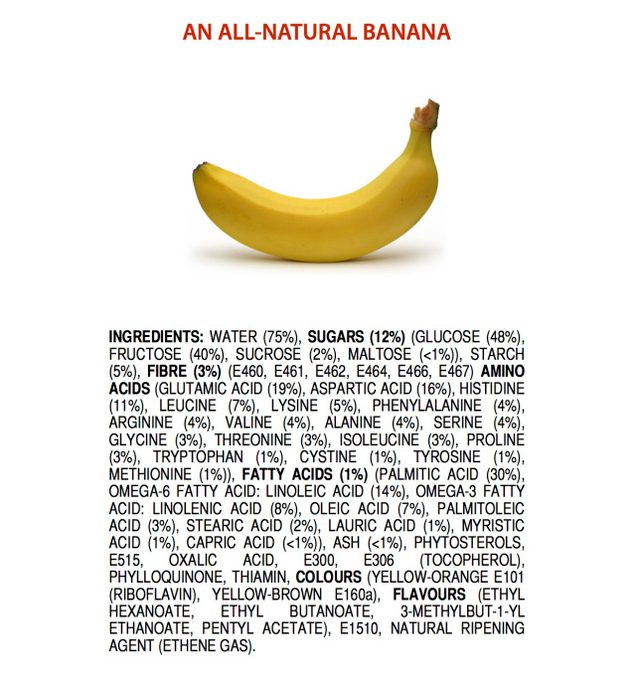
How "synthetic" they are depends on a bread (toast bread vs. normal, etc.), but a reminder - "bread" is not an atomic ingredient; even the most "natural" one would have a bunch of them on the label. Also, note the ingredients of a perfectly natural banana:
https://i.kinja-img.com/gawker-media/image/upload/s--o2mC_ak...
--
The point being, many people - myself included - consider preparing many of our meals a chore, not a pleasure. Preparing a fancy dinner every now and then is cool, but having to do that every day cuts into free time we'd like to use for something more interesting. I don't see why so many people have a problem with that.
At risk of constructing a straw man, it does appear to be a widely aired view that we ought to go back to "all-natural" meals cooked from raw fresh, organic, non-GM ingredients. In my experience, vanishingly few people actually do this, because it actually is a hassle and doesn't fit well within our modern busy two working parent lifestyles. Indeed, within your own reply you treat the innovation within the food industry with disdain.
I agree that, often, food innovation has optimised for the wrong goals: strictly prioritising convenience over health, for example. But whether you like Soylent-related products or other innovations in food, it's astounding the number of people who are willing to publicly attack engineered food products simply because it's not natural enough for their preferences and lifestyle. But those same people do not care about the naturalness of all the other technology they use.
With convenience food, I believe the proverbial cat is out of the bag and there's no putting it back in. Short of a massive economic/technological disruption that gives adults in families as much free time as they used to have, it's quite unlikely we'll see a revolution in home cooking. Maybe Soylent and other engineered foods are actually healthier than living off takeouts and microwave meals - as many people do - and are worth investigating further, without overly harshly judging those who currently find themselves in situations where they can't find time to prepare home cooked meals every day.
As for family time: Why not both? My mother made it a point to have me hang out in the kitchen and help out and, as a result, I like cooking and know how to do things ranging from "What do I have left in the fridge?" to "Alright, let's make something fancy". Obviously having the kids use knives isn't smart until they are older, but just having them peel potatoes or hand you stuff is a good bonding experience. And, when they ARE older: you got yourself some cheap labor
And, to get back to the skillset thing: That really helps with saving time. I generally DON'T plan my meals (weekends when I am not out and dates are the only times I really use recipes). My food shopping is generally "What is on sale? Alright" and then I roll from there. And a lot of that goes down to being a kid and watching my mother figure out what was left in the fridge. Sometimes you make an awesome quiche or casserole. Sometimes you just throw some rice in a pot, saute some meat, and then throw a can of vegetables in near the end. And sometimes you are eating bologna and ramen.
Nobody sane is saying to go super all out or to never eat out/eat takeout/frozen food. But home cooked meals are generally healthier, a lot cheaper, and teach kids how to eat right and fend for themselves.
Because cooking isn't everyone's idea of a good time.
This is also targeted at people who are choosing fast food over home made food because they want to, not because they have to.
Innovation is great, but if you read the article it talks about many benefits to making food, I'd say the intangible benefits are the greatest, i.e., purpose and accomplishment.
You talk about doing things with your kids. Sitting down with kids and eating a meal is an important family bonding time.
You analogies made no sense. The clothes and cars are get washed and fixed the same way. Soylent is NOT the same as eating real food.
If I had to guess - and I do - I'd wager that his family just orders in or goes out for dinner more than others. And as a new parent myself, I can completely understand.
I don't hate cooking meals
I hate all the fuzz around it - getting ingredients - do I buy "organic"? is that expensive? how cheap should I go?; finding the right recipes - how do I compare 20 different ones from the web? Which are more healthy? Dietary recommendations are all over the place - high carb / low carb / high fat / low fat / vegan / paleo / I don't know what all is there.; finding out what I forgot to buy, throwing out the old stuff that are starting to rot in my fridge, then spending another hour cleaning all the mess...
The cooking part is - at least for me - always the easiest - just follow the recipe. I hate the worrying before and after.
> do I buy "organic"?
Don't worry about it yet. Buy conventional - that's what you're eating when you eat out anyway.
> is that expensive? how cheap should I go?
Don't worry about it yet. Grab whatever is on sale to start. If you notice you don't like it, don't buy that brand again.
> finding the right recipes - how do I compare 20 different ones from the web?
Buy three cookbooks to start: Mark Bittman's "How To Cook Everything", an America's Test Kitchen cookbook that appeals to you, and a cookbook of a cuisine you enjoy that's popular on Amazon. Alternate between the three.
> Which are more healthy?
Don't worry about it yet. Whatever you cook from these cookbooks will be better for you than what you get from takeout.
> Dietary recommendations are all over the place
Don't worry about it until later. Get cooking first. Whatever you cook will be better than what you get later.
> finding out what I forgot to buy
This is a matter of making a list before shopping. I suggest buying for two meals max at first.
Nobody worried about most of this for thousands of years -- you don't have to worry about it either.
If cooking is something you're interested in picking up, I'd recommend starting simply. Pick a couple of meals (maybe a breakfast and a dinner). Get used to them, then start cooking variations, then move on to other dishes. I'll admit, I can be satisfied eating the same meal on a regular basis. And this doesn't prevent you from going out, either.
I've heard of people having good success with the Ti Ferriss' "The Four-Hour Chef". I'm sure there are other good references, either bound or online.
> do I buy "organic"?
I don't know. Try it and see if you find it's worth it. It's not like if you buy organic one time you're locked into doing that forever.
> how cheap should I go?
How is somebody else supposed to answer this question for you? Go as cheap as you feel comfortable. If you find the quality is too poor, buy something more expensive next time.
> how do I compare 20 different ones from the web?
You try them and see how they work out.
And so on.
Seriously, you don't need a detailed 50-point plan for every little aspect of doing something. Experiment, Evaluate, Adjust. It's not that hard and the stakes are pretty low. Worst case scenario: you end up making a meal you don't want to eat and you learn something.
Everything is packaged so that you're either finding ways to use up ingredients or you end up throwing them away because they've expired. Some foodstuffs come in smaller servings which is a blessing but the costs add up.
Also, I'm aware that my plans change frequently, so I avoid buying much meat and fish -- enough for two meals, at most.
Also, this makes a great analogy for software development and a very good point about Free Software (hands-on), proprietary software (you control at least the information flow into and out of that blackbox) and services (you have lost any control over where your personal and business data is routed through and sent to).
Just like some people aren't into coding, some people aren't that into cooking. One has to eat to survive, but this doesn't automatically make cooking interesting, especially on a daily basis. Many of us (myself included) simply want to get on to the eating part and save the time for something more interesting (be it reading books, playing games, building stuff, spending time with children...).
Cooking gives you a unique opportunity to be experimental, algorithmic, and potentially experience a small part of a variety of cultures. The programming mindset maps very well to it. It's also great SO/family time when done jointly.
For people who hate cooking, I recommend trying to find a recipe that seems out of your league. That's what really got me going originally. Nowadays I'm pretty confident trying to whip up nearly anything (though I'm not making fancy, artistic-looking dishes certainly).
Home cooking has it's own challenges. Less space, still have a lot of cleaning, and can't magically divine all sorts of cooking oils and what have you because the scale makes it impractical.
That said, cooking for 1 is a lot less exciting for me than cooking for 2+. If I were living alone I'd probably still eating packet Ramen a bunch.
One key to doing a weekly cooking time is setting aside the time to do it leisurely. If you're not rushing because you're hungry or in the middle of a busy week you can prep/cleanup properly (I use the time to cleanup my kitchen before the week a bit too).
I save money, eat a bit better, and clean my kitchen more often because I took 1-2 hours out of my weekend during a time I'd just be sitting around mourning the end of the weekend anyway.
I don't do it every weekend if I exhausted myself during the day with other projects... but I used to HATE cooking but I've really started looking forward to it. The end result is really satisfying and I feel like it produces a small ongoing feeling of accomplishment that I've really been missing.
Another thing that's been helpful is big roasts. turkey breast, pork shoulder, etc are very easy to toss a quick seasoning on throw in the oven for 2-6 hours, plus are pretty cheap ($2-$3 a lb, though a bit of that is bone). Gives you some meat to work into all sorts of things for the week with pretty low effort cooking.
With that, a carb staple and random sauteed veg you can get pretty far.
If you look at some of the traditional kitchens in the South of France (just as an example), you'll see tiny spaces with very small counter spaces and limited cooking/sink areas and yet awesome food come out of those kitchens.
Alternatively, I also prefer to cook only for me. I can take the time I want. Retry as many times as I want. And don't have to take into account the other persons tastes.
[0] And I know this is a juvenile sentiment. I have learned to deal with it but it's just too damn annoying.
I wouldn't say it's juvenile. Progress is about getting rid of the bullshit you don't like doing in order to have more time for things you like doing.
If people find value in it, they will take the time to cook. I learned to cook because I found value in it. Others don't, and that's okay. I really like that I can bring something to a pot luck and everyone likes it, or that I can bring joy to a friend for a meal -- that's something I value.
If you don't value that, it's fine. We make choices.
If you are on this site and value it but don't know how to start, take a class. Most people here are in a place where they can afford six weeks of classes to learn the basics. But doing it out of guilt is silly.
What if people haven't thought of the benefits that this article is suggesting?
However, it happened at the phase of life when I was ready for it. And when I've mentioned this in conversation, I don't remember anyone saying, "I don't need to know how to cook" or "I don't need to learn to cook more than the basics." It's "I don't have time," or "I don't enjoy cooking/cleaning," or "I'm too afraid to mess up."
As I've grown older, it's changed. I'm around mostly people in their thirties and most people had the same experience as I did where they realized they had reached a point in life where they needed to learn to cook.
Now, I realize that I'm a mediocre cook and anyone with a mere week in a decent restaurant is likely a better cook than me. However, I acquired a reputation of a good amateur cook in some circles. I couldn't imagine being in a place where I didn't cook well - it brings so much to my life. I just think the shaming over it all doesn't work because the motivations don't line up.
Something we too often struggle to accept.
It used lines like "Don't you hate wasting 10-20 minutes every morning choosing your outfit?", "Don't you hate shopping and trying on clothes that probably won't fit?". And no, I can't say I've ever felt like that. I enjoy the time spent dressing myself. I like shopping for clothes and thrifting. That shirt basically wants to take away everything I like about clothes.
I guess this is how other people feel about me "eating" mostly Soylent. They love food and don't understand how someone else would want to not spend their time choosing or preparing food, or how someone could eat the same thing every meal. Someone who would be interested in this shirt doesn't really care about changing up their looks everyday or their clothes looking unique. Just that they look decent and clean, and don't waste too much time or money doing so. And I don't necessarily care about my food being varied or flavorful, as long as it isn't unhealthy and is simple to prepare.
"But think about the benefits, when you make your own meals you are saving money, rather than paying a chief, tip, delivery fee and markup, you only pay for the ingredients."
If you think even a little bit, it is obvious, that producing prepared food at scale is more efficient than cooking it for yourself.
"as you learn to cook you gain an important skill, you gain independence ... being self-sufficient"
Right, drive yourself to work instead of using mass transit, make your own clothes, furniture, assemble your own microchips (you surely can't be a developer/admin without a microchip, so that one is very important to be self-sufficient). Don't forget to dig a hole and pump your own water!
Fallout is coming, we all need to cook right now!
Oh, and also it is much more interesting, than spending the same time on reading news/books or making something for other people!
You've read one article with one suggestion and made a massive sweeping assumption about the authors intentions, good job.
Also, irrespective of any assumption I might had (or not) about the author from a long post, you go much further assuming you know I had one, and that you know it from my single small comment half of which is original author's quotes.
I've been eating to be satiated, because I know I have enough calories to live.
I just found [this article](http://www.sciencedirect.com/science/article/pii/S0924224414...) and it seems to reflect what I personally experience.
Preparing your own food doesn't have to be that complicated.
Open box, deposit in container, add milk
Take sandwich, apply peanut butter
I haven't done any of that for years, because now I'm living with crippling depression, and I often face the choice of spending my energy for the day on work, on housework, on life maintenance, or on eating well. I only get to choose one at the most. So most days I live on ready meals, supermarket pizza, pasta, etc. I buy Joylent (EU version of Soylent) because I reckon it's got more nutritional value than most of the ready meals I'm eating, and it's very quick to make - useful on days when I have to drag myself out of the house and don't have time for breakfast. It's also cheap - which is good, because depression means that I don't get many billable hours worked these days.
So, yeah. I'm probably nowhere near the common case here, but I just wanted to present a case study to show that not all of us meal-replacement users are just "people who haven't learned to cook properly yet" or "people who don't care about food". We're a diverse bunch.
That makes getting ready-made food harder, too: my supermarket only does a couple of vegetarian/seafood ready-meals per category (two curries, three italian meals, no Chinese meals at all!) so I find myself eating a very monotonous diet anyway.
Nevertheless, I don't use Joylent full-time: I just have a box in my cupboard for when I need an emergency meal or just can't face another plastic tub of macaroni cheese.
Thought experiment: what do you imagine the diet of the average human will look like 100 years from now? 200? I'd wager that if your answer involves a grocery store, fresh produce, slaughtered livestock, etc. then you're mistaken.
I'd wager that if your answer to the future human diet in that timescale relies primarily upon such pre-packaged subscription services, then you're even more mistaken.
Thought experiment: what do you imagine the diet of the average human will look like 100 years from now? 200? I'd wager that if your answer involves a grocery store, fresh produce, slaughtered livestock, etc. then you'll be wrong.
I like having a smartphone with me because it allows me to do things I couldn't reasonably otherwise do -- but it can also be used as a crutch for things you don't really need a smartphone for. I've started looking for ways to solve problems that DON'T involve popping open a google window or launching yelp. Simple stuff like memorizing routes I want to take before I start so I can navigate with my eyes ahead rather than in my phone, asking friends for food recommendations, keeping eyes out for posters advertising upcoming events. For me, making life less convenient and reducing instant-gratification is helping me enjoy the ride more.
(yes, this is 100% a first-world-problems comment)
That being said, I would never replace any of my other primary meals with it because I love cooking too much. I typically spend an hour or two on Sunday making two meals of 4 - 6 servings that will last me through the entire week and then I take off Friday and Saturday and eat out.
Telling them to cook really just amounts to ignoring their priorities.
I urge any HN users that use Soylent to really give meal preparation a try. You can prepare a dozen health meals in half an hour on Sunday night and your lunches and snacks for a whole week will be good to go.
"There is a difference between knowing the path and walking the path" and cooking your meal every time!