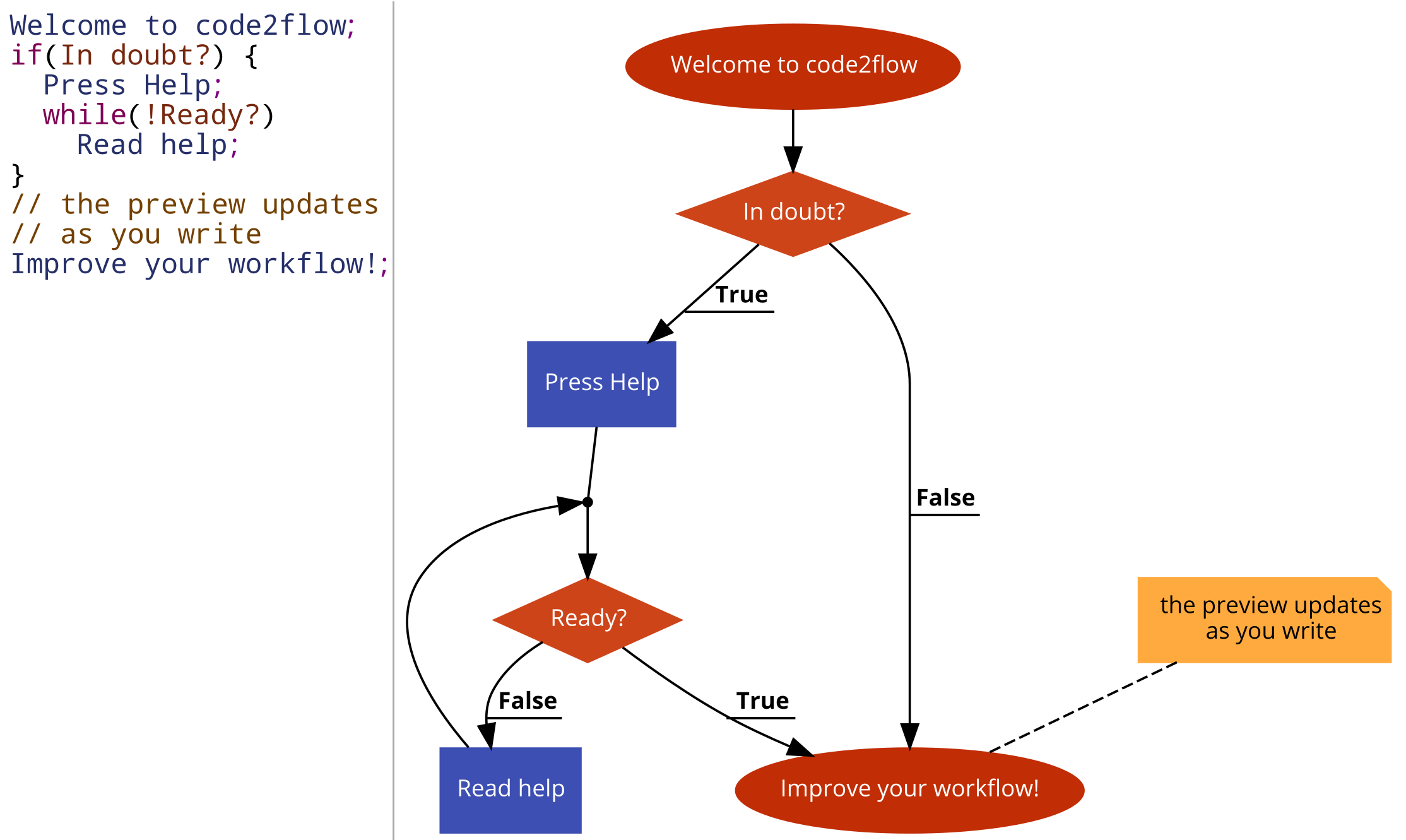
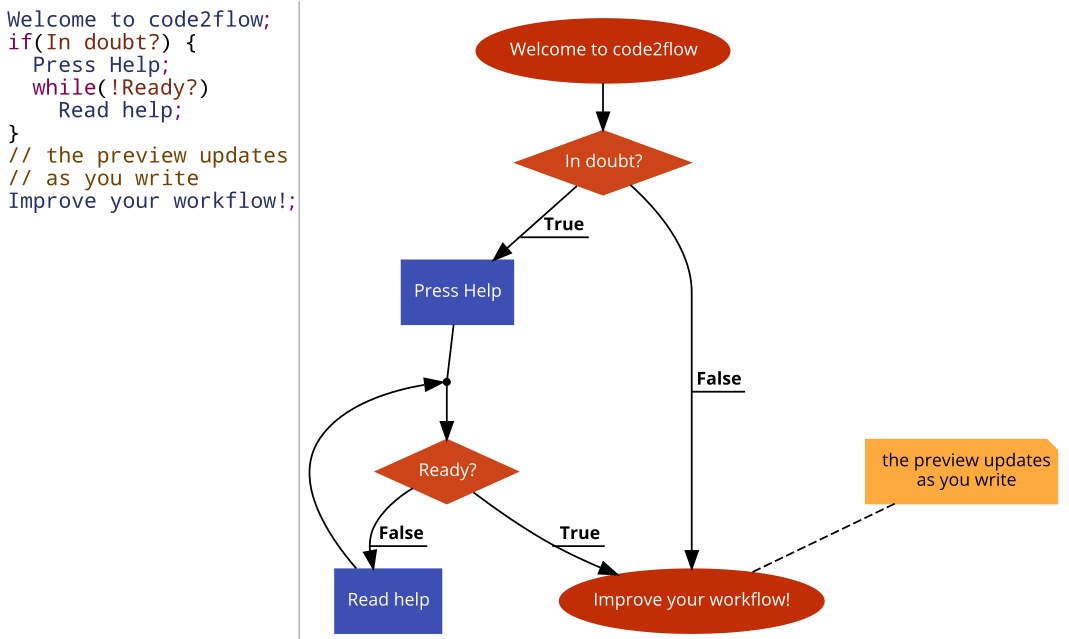
I did notice one annoying bug, as I change and break the code sometimes, the editor just stops working and it's hard to tell what's happening (the loading indicator just stays there). Opening the dev tools, it appears you're not catching all errors when your parser (peg.js) fails.
SyntaxError: Expected ":" or [^\t\n\r :;[\]] but "\n" found.↵ at peg$buildStructuredError (https://code2flow.com/worker-flow.js:2:12222)↵ at Object.peg$parse [as parse] (https://code2flow.com/worker-flow.js:5:1413)↵ at exports.FlowWorker.onUpdate (https://code2flow.com/worker-flow.js:5:4410)↵ at callback (https://code2flow.com/worker-flow.js:2:8619)"Font-resizing would be nice on the visual view. And killer feature would be two way interaction, but I can imagine that's a tricky one.
Here's a generic "SaaS subscription workflow" I made up in about 20 mins.
Love it!
As for $100/$300 pricing, these are on premise business/enterprise versions meant to be used by bigger teams where data confidentiality is crucial.
Also how do you win against competitors? Is this project something that couldn't be duplicated in a week or so? No disrespect intended, maybe there is more to it that I'm seeing.
The pricing for individuals is gonna be published soon along with the SaaS product. It's probably gonna be something like $10/mo but still couple more features need to be built to justify that (like permanent links which content can be edited)
As for the $100/mo - we do have business/enterprise customers who find lots of value in it. I guess the price has been initially verified by the market so should I justify it?
I guess I can justify the price by saying that the project has taken numerous hours of engineering, testing and experimenting. I think this is natural in pricing models that bigger customers pay more.
If you can do the same in a week than good for you.
Peace and take care :)
I absolutely support you charging as much as people will pay! It sounds like you have already started to prove the model. Wish you success.
the 'justification' is people paying for it. if they find value, they pay, there's the justification.
Generally, you can charge whatever you want in capitalism so the pricing structure is justified apriori until it fails.
*Clarification: in the software market, which is generally very low barrier to entry (provided you already have programming knowledge)
PlantUML was one of the first I've ever tried, and nothing beats it so far. Sometimes it's not as flexible as I would want it to be, but maybe that's why I like it so much? I think I've almost learned to use it to only care about being able to express what I want to, and if it doesn't look exactly how I want it to look, but it still lets me express what I want to, I'm happy enough.
I am surprised at the amount of people that have never heard of it. It is probably already installed on your Unix system. There are several implementations with various improvements, such as https://ece.uwaterloo.ca/~aplevich/dpic/
I think it is dead now last known location http://figr.bzero.se
2. Is 'pseudo code' the best description to use? Even the word 'code' can put non-technical people off as they associate it with complexity.
3. The pricing: hosting and support are good reasons to pay, but 'full confidentiality'? It seems you are going out of your way to make the product insecure because the user is not paying. It comes across as a bit money-grabbing.
4. The gif on the front page works well to show off the product simplicity in an intuitive way. My only thoughts is the flowchart could do with looking a bit more 'web 2.0'; SVG elements so you can have rounded corners, shadow effects, colours that work together, arrows that look more professional etc.
The phrase "data sovereignty requirements" comes to mind.
I'd just list 'fully secure' or 'encrypted' as one of the features, and not put it in the price plan at all.
True enough on the Web 3.0 look! I'd recommend using one of the many colour palette tools on the Web though, just to get a more natural softer look between the various hues.
https://atom.io/packages/diagrams
and
https://www.npmjs.com/package/diagrams
Desktop oriented for offline use.
I think StackEdit is another tool to create flowcharts and sequence diagrams.
https://github.com/benweet/stackedit/blob/master/public/res/...
We can create a flow chart with following markdown.
```flow
st=>start
e=>end
st->e
```
I've used graphviz for a bit, which is similar in mindset, and I can see myself using this, as a product.
Now I think the pricing can be a little bit too much.
I prefer echo "digraph G {Hello->World}" | dot -Tpng >hello.png
For a stretched example http://www.graphviz.org/Gallery/gradient/cluster.html
Current paid versions are more for bigger teams and companies requiring on premise solution.
    digraph  {
            "Hey" [shape=circle]
            "Welcome to graphiz" [shape=box]
            "You are new" [shape=diamond]
            "How are you" [shape=box]
            "It's super easy" [shape=box]
            "write plain english thats code like" [shape=box]
            "wanna do a condition" [shape=diamond]
            "editing"[shape=diamond]

            "Hey" -> "Welcome to graphiz" -> "You are new"
            "You are new" -> "It's super easy"[label=True]
            "You are new" -> "How are you"[label=False]
            "It's super easy" -> "write plain english thats code like" -> "wanna do a condition"
            "wanna do a condition" -> "Just write an if"[label=True]
            "wanna do a condition" -> "editing"[label=False]
            "Just write an if" -> "editing"
            "editing" -> "How are you"[label=False]
            "editing" -> "see stuff update via entr"[label=True]
            "see stuff update via entr" -> "editing"
            "How are you" -> "goodbye"
    }
dot above.gv -Tpng -oout.png
This is basically what has been preventing me from using https://monodraw.helftone.com/ - i didn't want to draw simple flowcharts. If this can output text for a sane price, you've got a customer!
(though, i would prefer an offline app, fwiw)
Your solution is something i've literally talked about here before, so it's welcome to see! But i still need/want ascii. I suppose i don't need it.. i just like being able to view things in CLI/etc.
Contact me if you want to talk about a pricing model that would make sense for my market segment. Maybe per-chart pricing.
The enterprise version is for companies embedding code2flow in their own products.
Many thanks!
It looks like you're used by people in healthcare, and they pay primarily for self-hosting.
My suggestion: replace "Data not confidential" with "HIPPA compliant" and double your prices. The free version works for 99% of people who just want to draw a flow-chart, and you charge reasonable prices to healthcare orgs that have to be extra careful because of regulations.
Start high and work your way down until you get consistent conversion ratios that match up with your personal goals.
OR start low and then keep increasing the price until you hit a conversion wall.
Both ways work!
This is an amazing read on the subject:
https://training.kalzumeus.com/newsletters/archive/saas_pric...
[0] GraphML https://en.wikipedia.org/wiki/GraphML
I played with a simple OAuth2 flow and it worked great. I'm going to see about using it for all of our documentation.
Business is probably too steep for us and we wouldn't want on-prem anyway. A Saas Pro plan might be interesting if it's affordable.
Note: Download to PDF failed silently for me. Printing worked great. I haven't tested SVG or PNG yet.
Can you share a really complex flowchart that uses most of the options?
The most complex flowcharts were created by customers and testers but I don't want to expose their data. They have hundreds of lines of code resulting in huge diagrams.
My brain jumps from the code being psuedocode to instead being actual Swift, and the chart would be displayed in the output section of an Xcode playground.
Anyone know if something like that exists? Or if it may be easy to port an idea like this to inside a Playground?