They were very much in a race with MIPS, Intel, and AMD. They won by doing the same thing everyone else did, but by doing it quite well.
Silicon Valley terminology is getting stupider by the day.
The ARM1 on the other hand was built to be simple (because the designers hadn't built a processor before). They didn't care at all about maximizing density (the layout is pretty awful). They cared about low power consumption only to the degree it meant they could use cheaper packaging.
But this low-end ARM processor managed to hit the low-power needs of mobile devices (starting with the Newton). And now the ARM processor is a serious threat to Intel, not because ARM out-raced Intel at the more-transistors game, but because ARM was a simpler, cheaper product that disrupted the market.
I think 99% of the people who use the word "disruption" haven't read The Innovator's Dilemma (and they should), but to me the ARM clearly fits the pattern in the book.
I can't but find that pretty admirable.
It turned out to be more important than any of these.
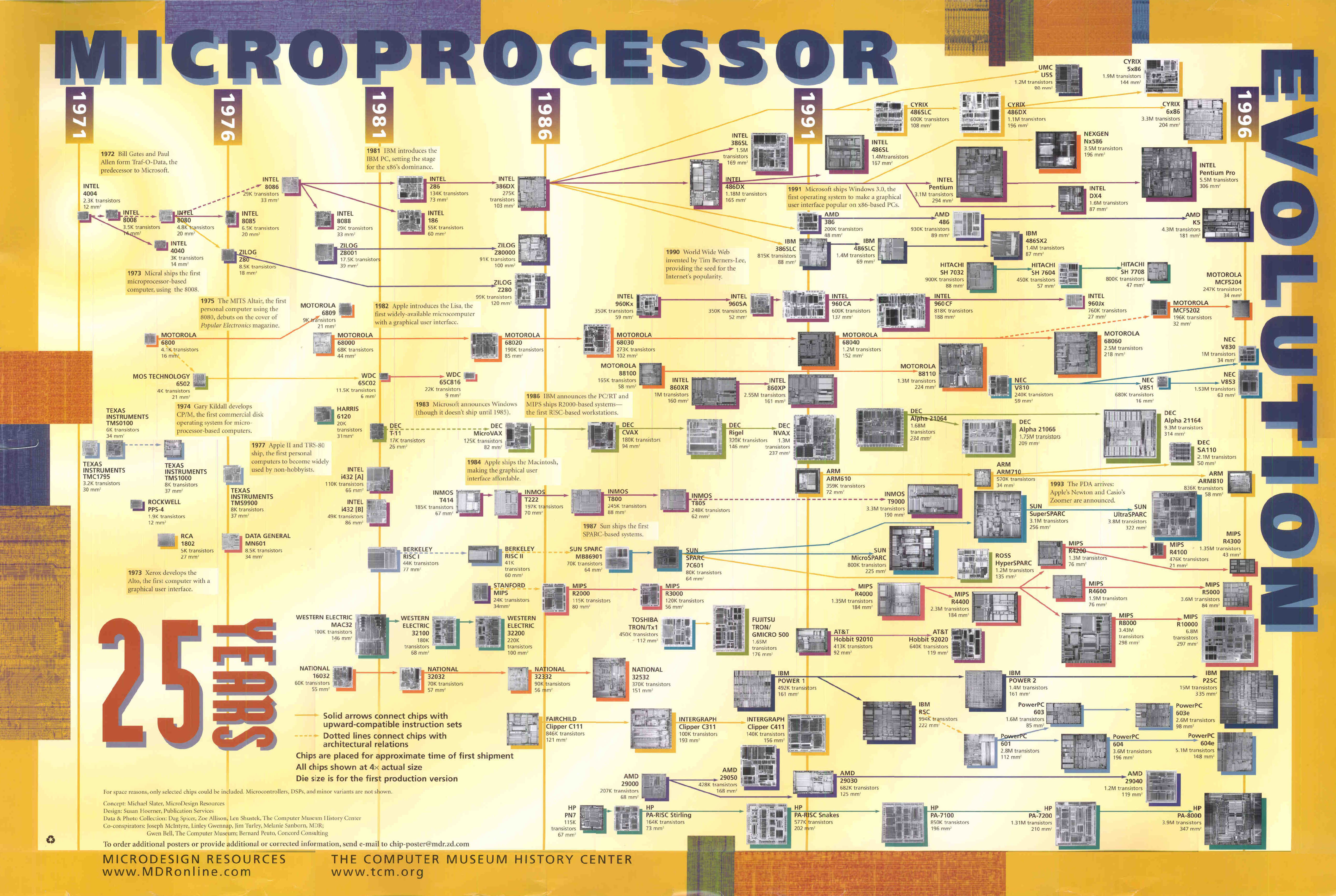
edit: ah they have the ARM, but not until 1991 for some reason.
I asked at reception and apparently yes, they do get funding from Intel...
Do go visit, though; it's brilliant. Not quite as good as the National Museum of Computing in the UK, which will let you go and play with a lot of the exhibits, and which has a working decatron computer, but it's still well worth a trip.
I would quibble about a few things. It shows an architectural relationship between the 4004 and 8008, which isn't the case. It shows the almost-unknown TMC 1795, but doesn't show its architectural relation with the 8008. It shows the TMS 0100 and TMS 1000 microcontrollers but not other microcontrollers. Lots of early microprocessors are omitted, giving the impression that not much was happening back then. The lack of ARM1 is disappointing; it shows ARM starting with ARM6. But overall a very interesting diagram.
We routed 6 layer PC cards on it ... all night.