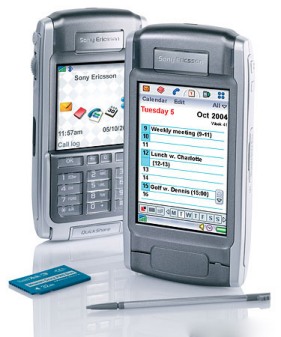
The reason phones didn't look like rectangles wasn't because no one had the idea, but because screens were expensive and touch technology (and other technologies like data) wasn't mature yet. That's why you had something like the LG Prada come out at the same time (or even slightly before) the iPhone.
Just because you are first to adopt something (e.g. because your customers don't mind paying a premium and you've secretly developed it for years including controlling the supply chain) doesn't mean you should have the sole right to use a concept derived from evolution of components.
P910 http://pdadb.net/img/sony_ericsson_p910.jpg
Neonode N1 http://images.dailytech.com/nimage/Neonode_N1_Sept_2004.jpg
Sony Clie PEG-TH55 https://cnet3.cbsistatic.com/hub/i/r/2010/08/03/b26d3392-67c...
LG Prada http://image.cellphones.ca/images/phones/74/767/lg-prada-ful...
Don't get me wrong: Apple deservingly got tons of credits (literally, in their bank accounts) for the combination of great hardware/software/ui design/marketing of the past 10 years. They still do.
But their success means that just like Jony Ive got "inspired" by Braun, Apple is not inspiring everybody else.
If you look at the mock-ups people made of the hypothetical and long-rumored "iPod phone" that Apple was working on you'll see how many of the design decisions Apple took were completely unexpected: https://www.engadget.com/2009/12/28/how-early-iphone-predict...
Apple didn't invent everything under the sun, and they didn't even "invent" everything they use. What they do is try hard to come up with a striking, simple design that they know will differentiate their products. They also get very upset when people steal their design without even trying to make it their own.
Notice how Apple's been quiet about the Microsoft Surface device, and even though it directly competes with the iPad, they're still partnering with Microsoft to build Office apps. I think they respect Microsoft here because re-inventing the tablet and making a compelling notebook product of that sort takes a lot of bold engineering.
Apple's appropriation of the keyboard cover (http://www.theverge.com/2015/9/9/9297805/apple-ipad-pro-micr...) is one of those things that's inevitable. I'm not sure what else they could have done here, they were boxed in, so it ends up being 'theft' by some definition of that term. Microsoft doesn't seem to have raised this as an issue, so I'm sure there was some communication here between the two parties to make sure it didn't poison the waters.
Xiaomi "thin, machine-metal" laptop looks as much like an Macbook as iPhone's 6 antenna lines look like HTC One M7.
Apple has been quiet about Microsoft (and vice-versa) because if Samsung v Apple design patent wars taught us anything is that it's pointless and expensive to engage in these fights.
Since it was released so close to the launch of the iPhone that it's not like Apple could have possibly dropped everything and rebuilt their entire design strategy around it. The protracted lawsuit with Samsung showed how Apple had been working on that design for some time and had already settled on a number of key design elements, the "rectangle" being one.
Those are interesting historical artifacts, but none of those had any lasting impact on the market, they were merely historical curiosities that nobody ever copied.
> Just because you are first to adopt something...
No, it doesn't give you an exclusive right per-se, but there's a lot of ways you can make a touch-screen phone short of copying Apple's design millimeter for millimeter like Samsung did.
So long as there's such a thing as a design patent then, legally speaking, yes, you do have the sole right. That's what patents are for. I'm generally not a fan of patents, but you can't argue that they don't exist.
There was incredible variety in the phone space prior to the iPhone, phones came in all shapes and sizes with vendors exploring increasingly implausible formats out of desperation. Post-iPhone they all converged, coincidentally I'm sure, on Apple's design. It's only now we're seeing some divergence from that.
Today we're seeing the same ridiculous convergence with keyboards where everyone plus dog is using the Apple layout. This hurts consumers since there's far little choice than there was before.
There's a huge difference between "copying" meaning "taking a good idea and giving it your own spin and making it even better" (e.g. Android vs iOS) and "copying" meaning "making a shitty knock-off version of a thing that looks almost identical to the other thing superficially", as in all the bargain-priced knock-off phones that are sold using Apple's branding (http://mashable.com/2016/06/17/apple-china-knockoffs/#qO0bF3...). Most companies fall in the middle here, but some skew very close to the bottom.
"Of those only the Prada is close"
No, the P900 was a smart phone and therefor a rectangular phone like the iPhone, but with a hardware keyboard in addition to the virtual one since touch technology wasn't very good. The Neonode had a touch interface because they had developed their own touch technology. The Sony PDA has a very similar design since it was made for using applications similar to what would later become common with phones when larger screen and faster processors became available. The LG Prada was also a premium phone, which is why it could look similar to an iPhone.
"they were merely historical curiosities that nobody ever copied."
Except Apple then I guess.
"There was incredible variety in the phone space prior to the iPhone"
Not really. Most phones looked largely the same with a keypad and maybe a joystick, because that was the state of technology at the time. Just like most phones look the same today, because of the state of technology today. Even if you wanted to make a different phone today there wouldn't be much point. Because you would have to create your own parts, your own operating system and your own application ecosystem just to be 99% similar to everyone else since you're using the same technology. Look how things went for Google Glass, which isn't surprising since the technology isn't ready.
"Today we're seeing the same ridiculous convergence with keyboards where everyone plus dog is using the Apple layout."
Do you mean the Sony layout? Because that's where the chiclet design was copied from.
http://www.cnet.com/products/sony-vaio-x505/
"as in all the bargain-priced knock-off phones"
Those are novelty phones, you literally have to search them out to find them. They have about zero percent of the market.
By that definition the Ford F-150 is a copy of the Porsche 911. I mean they both have four wheels and an engine and things like door handles and windows.
The Sony x505 has "chiclet" keys, but they didn't invent them. These things were on calculators decades prior, and infamously the IBM PC Jr.'s wireless keyboard.
What I'm talking about is the peculiar arrangement of the arrow keys and other subtle things that are very distinctly Apple. Given how quirky some keyboards can be, where seemingly every vendor has their own spin on how big the Caps Lock key should be or where backspace should be positioned, they're all using Apple's keyboard as a blueprint going forward, literally copying it.
Apple's fairly unique arrow key layout showed up in early versions of the iBook and other Apple machines in the 2000-2001 era, possibly earlier.
The iPhone redefined what a smartphone should be using nothing that wasn't available to anyone else in the market. Except, perhaps, a Jony Ive with a mad man like Steve Jobs pushing him.
That said, the unibody MacBooks set the gold standard for stylish laptops. It's natural someone else would follow the formula many years later. Even with only evolutionary changes, the MacBook is still light years apart from its Windows-running copycats.