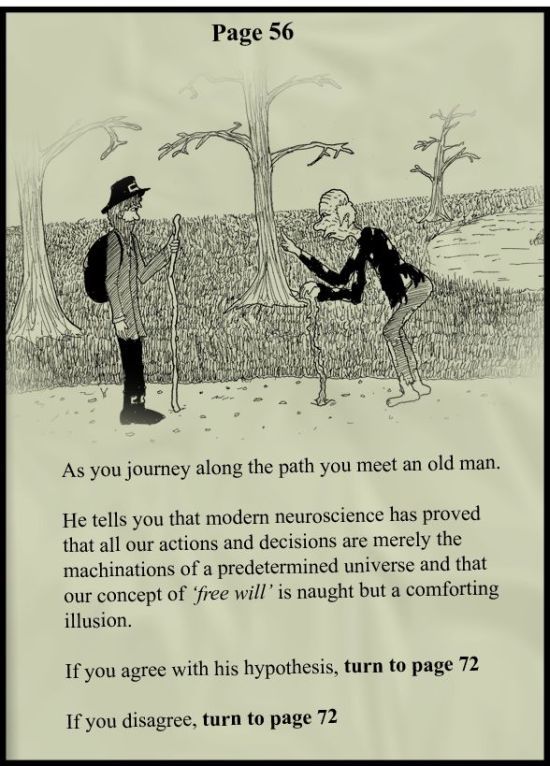
"Free will" is the hypothesis that it is, in principle, impossible to determine the outputs of a brain just by measuring its physical state with perfect accuracy. In other words, if you have two physically identical brains, with physically identical states, these brains can have different outputs.
So, two brains as physically identical as possible will probably have (slightly) different outputs.
But those differences would have nothing to do with human will. They would be random, or, more precisely, non-deterministic (per definition, as you can't measure them). So, having a non-deterministic free will is like having no free will at all.
Conclusion: We have no free will nor fate ;)
If you hold a prior belief that the physical world is all there is (or that physical explanations are the only valid explanations, which the physical sciences take as their starting point), you can come up with endless circular rationalizations of materialism.
This, at least, is the attitude that many people have to ghosts, gods, and werewolves.
This is why scientists make bad philosophers. They do not acknowledge the boundaries of their philosophy.
The you that lifts your arm and the you which feels like it decided to lift your arm are on different schedules.
When I see a person who grew up in a wonderful environment with presumably good genetics, judge and condemn someone who did not, I wonder how they justify their superiority. It's as if they believe that, if they were that person, they would make better choices and do better things with their life. My question is, if you were that person, with exactly the same genetics and environment, then wouldn't you, by definition, BE that person and live your life in exactly the same way?
I suspect their answer would eventually come down to something about a "soul" which, even if it exists, would still be something that you were born with and thus completely out of your control. So, again, I would ask how they deserve their superiority, especially if they don't go for the soul argument.
I can then imagine some of them going for the "I deserve it because I was so awesome in my past-life.", which also doesn't hold up because it's a circular argument. So, again, how can they justify their superiority?
I'd say it's just luck, but I can see some people using that as an excuse to never do the right thing. "I was born this way so that's how I'm going to be." I could probably argue with myself for hours about this kind of stuff.
I'd personally go with "I deserve it because I was so awesome in this life."
Would anyone take seriously an article like "Phagocytosis is a myth, philosopher says"?
I have never seen evidence of such a machine, so I don't think you can prove it either way. I like to believe whichever theory seems to benefit me most at the time.
I'm curious about your "I like to believe" stance. Are you saying you'll ignore any evidence for any theory if you don't think the theory benefits you more than another theory, even if your theory has been shown to be wrong?
What's more, your beliefs about free will get integrated into the algorithm as well; someone who believes that they are not responsible for their actions will behave quite differently than someone who believes they are capable of choosing. Like many human ideas, free will is a necessary (or at least, useful) illusion.
What the article essentially says is that our brain is nothing but a CPU, programmed over millions of years by natural evolution in a way that it gained all kinds of responses to multitude of various inputs (our 5 senses) in all kinds of combinations, self-improving learning algorithm, and that illusion of consciousness emerged as a by-product of this complex system. Pretty interesting what exact data-structure/algorithm/etc caused this peculiar side effect.
It could have something todo with the observation that our brain doesn't need to be whole in order to have consciousness. In different types of physical brain damage, even major ones, a human was able to remain conscious. Same could happen with the other part of brain damaged, which was healthy in another example. So I'm thinking - maybe our the sense of conscoiousness is like a potential difference which makes electrical current flow through the wire - you need to have multiple parts of brain with potential difference to create an illusion of consciousness. This is pretty vague but I like this concept - may be onto something. Consciousness does feel a lot like different parts of brain interacting, or one part /observing/ another and reacting to it just like it'd be reacting to the outside world.
Meh.
You would think the belief in free will, or its absence, becomes a feedback mechanism in human behavior. How many different ways can that seed be planted? Why does the belief/disbelief amplitude vary among individuals? Is the belief/disbelief meme just another meme that's been around a long time, and affects us far less than we believe? I once knew a successful Indian woman who completely believed in fate, which surprised me because with all her energy and drive I thought she was living her life as a free willer.
http://chu.stanford.edu/guide.html#ratmech
My favorite line in the paper, cogito ergo sum should be cogito ergo eram :)
It's all Chu spaces -- enjoy!
There are no new ideas, just new implementations.
Now whether or not I was programmed by the universe to make that decision that way or not, from the outside there is no way a universal observer could determine what eventual choice I would make. It easily passes the duck test as being free will.