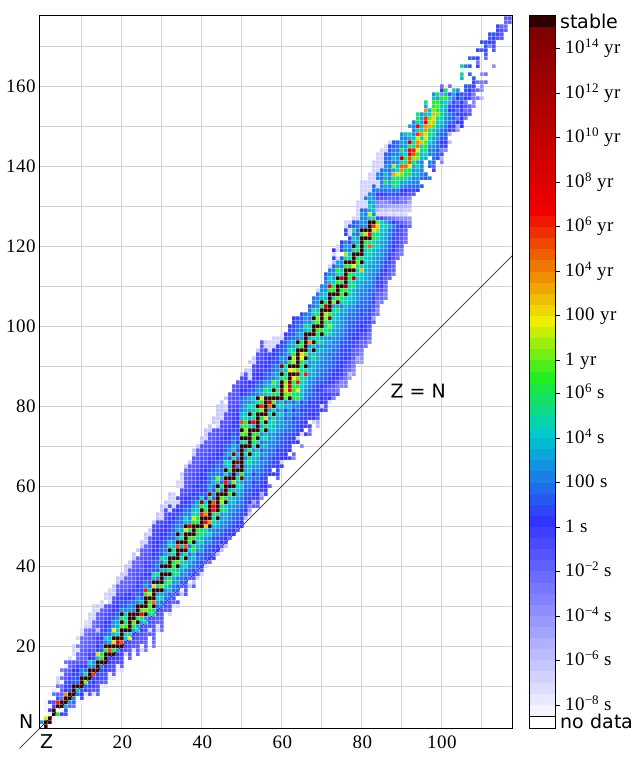
That's because we've only discovered or figured out how to make a finite number of them. Is there a reason that other (alien) elements can't exist that we've never been exposed to?
In addition to the stability argument, there are also energy requirements. It turns out fusion (stars) only gives energy up to iron, then it requires energy to make bigger atoms. In other words, you get energy back out when you split big atoms (I.e. nuclear reactors). In nature, all elements past iron are created only in the spectacular energies of supernovas, which occur in less than a second.
Basically, we have a really good grasp on the elements that can exist. We're only missing the details on a few things that occur on nanosecond and less timescales.
That's actually a common misunderstanding. If you fuse hydrogen (or even lithium) with iron, you can get a higher numbered element and some excess energy. See the chart on this page:
https://en.wikipedia.org/wiki/Nuclear_binding_energy
While iron is at the top of the curve, that just means you won't see iron-iron fusion. There really is no reason the lighter (common) elements can't fuse with the heavier elements.
This is also the idea the LENR (low energy nuclear reaction, formerly known as cold-fusion) guys are considering. If you fuse Hydrogen with Nickel62 to produce Coppper63 you could get some energy out. Notice that Nickel is already heavier than Iron. Some claim to have seen this copper production in hydrogen-nickel cells. The claims are not really relevant - the math supports it as a possibility. Weather it can happen on earth or in a star is open for debate. One key question is how the excess energy would get out as heat, and there are ideas about that.
I for one find it amusing that people don't think something like this is where all the naturally existing heavy elements came from.
Furthermore, the formation of elements in the Universe is also a fairly well understood process. For elements lighter than Fe it generally occurs through nuclear fusion in the center of stars. For elements larger than Fe it generally occurs through the r-process and s-process. With these we can model nucleosynthesis extremely well and it gives us a very good idea of the elemental composition of the Universe. That being said, there could be some crazy unknown element out there but it would contradict almost everything know about atomic physics.
[1] https://upload.wikimedia.org/wikipedia/commons/8/80/Isotopes...
Even if such elements are out there in the universe in tiny quantities, we'd run into a billion carbon-based biospheres before we found any.
(This only works if the element is common enough and hot enough to emit light that is seen from Earth.)
Yes, because you form new chemical elements by adding protons (and stabilizing neutrons) to the nucleus, and humans have found or synthesized the first 118 of these. The ones that don't occur in naturally on earth are short-lived an unstable.
Of course, this is today's understanding. We may be wrong. :-)