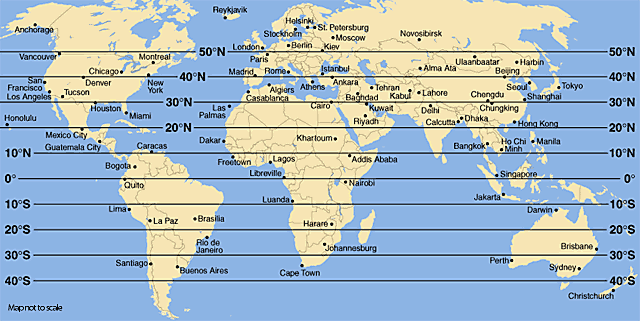
"Time" is not a thing that cares what side of the planet you are on, and it makes international scheduling and communication literally hell when you have to calculate time zones.
If we are going to fix time, we should switch everyone to UTC time. If you want to go to work in the dark and leave when the sun rises, have your company schedule hours accordingly. Changing DST now doesn't change that, your business is still setting hours arbitrarilly based around an archaic model of "wake up at 7 work 9-5 go to bed at 11" no matter where you are on the planet. It just makes no sense, and is simply culturally normative so people expect it and structure their internal model of time around it.
It actually makes a certain amount of sense. There are people who have to work in the daytime, e.g. because they work outside. Farmers, construction workers, etc. Then their administrative staff needs to work at the same time as the outside workers, and their customers and suppliers need to work at the same time as the administrative staff, etc. So everybody works 9-5, where "9-5" is some approximation to daylight hours.
But changing clocks twice a year is still stupid.
There is no reason why Bostonians should have to tolerate 4:15 sunsets. The most frequent modern objection I hear is that children will have to go to school in the dark, but school schedules aren't orbital mechanics: Shift those around instead.
Pushing school times back an hour would be a big disruption for a large percentage of the population.
Also I actually enjoy having the yearly ebb and flow of daylight getting spiced up with some predictable discontinuity, but I see how this is a personal preference: It gives me a clear marker for when to stop bothering with the little remaining after work daylight which is less frustrating than being torn on the threshold for weeks.
> Between 1986 and 1995, fatal traffic accidents rose 17% the Monday following the switch to Daylight Saving Time.
Accidents rose 17% that Monday? Does it mean 17% more than any other day, or just that the raw number for that Monday is 17% higher than it used to be? Because they worded it like the latter.
For all this page says, accidents were up 17% every day of the year over that decade.
EDIT: Wikipedia says total US traffic deaths were lower in 1995 than 1986, so I'll chalk this up as poor wording. https://en.wikipedia.org/wiki/List_of_motor_vehicle_deaths_i...
I highly doubt that one less hour of sleep on one day of the year can affect that risk by so much. If that were the case, I assume the risk of heart attack would be much higher than it is now.
This same numerical trick happened when the WHO classified red meat as a carcinogen "in the same category as" cigarettes, and it was stated that it increased your risk of some cancer by ~50% (or something), but the baseline risk is so low that it's a lot less dramatic than it sounds.
http://www.degruyter.com/dg/viewarticle/j$002fbejeap.2007.7....
From the abstract:
> Both models reveal a short-run increase in fatal crashes following the spring transition and no aggregate impact in the fall. Employing three tests, I decompose the aggregate effect into ambient light and sleep mechanisms. I find that shifting ambient light reallocates fatalities within a day, while sleep deprivation caused by the spring transition increases risk. The increased risk persists for the first six days of DST, causing a total of 302 deaths at a social cost of $2.75 billion over the 10-year sample period, underscoring the huge costs of even minor disruptions to sleep schedules.
I still have no idea where the 17% came from or what it's relative to. If anyone else finds it, please fill us in. Am I missing something, or did they borrow a made up statistic out of a clickbait image macro and link to a vaguely related paper as cover or something?
People are fine with the time system, especially since timezones themselves are somewhat arbitrary in their regions. DST is actually more comfortable to live with by allowing for more daylight after work hours. It would be better to just switch to DST permanently and avoid the constant frustrating changes.
Is adding a permanent 1-hour offset to all of our clocks really a more sensible solution than convincing employers to shift their schedules one hour earlier?
It just sounds kind of Kafkaesque... your boss has set your schedule too late in the day, so your solution is to trick him by winding all his clocks forward by one hour.
I think you're analyzing it from the perspective of mathematical logic. In an isolated perspective, one employer (instead of all employers), can arbitrarily change the working time as 7am-4pm instead of 8am-5pm because it's mathematically equivalent to the +1 hour DST.
But society wants to coordinate on a bigger scale than that one employer you were able to convince. (Children's school hours, restaurants, tv schedules, customers calling help desks, etc). Also, the math viewpoint ignores the fact that there are long standing cultural anchors tied to specific times such as 9am-5pm[1].
The bottom line is that it's easier to address the coordination problem by hacking the time via permanent DST rather than adjusting everyone's familiarity around nominal times. Changing out the nominal times displayed in glass windows doesn't look easier than implementing DST. Even changing nominal times in the digital realm is a hassle: think of all the recurring meetings in MS Outlook, Google Calendar, iPhones reminders, etc that say 10am-11am. Millions of people would have to change those times to say 9am-10am. Again, leaving those nominal times the same and fixing it more "globally" via DST seems a lot simpler.
[1]https://www.google.com/search?q=store+opening+closing+times+...
The point is, for a lot of people (if not most of all), the timetables don't need to be changed. If my working hour is 11am ~ 12pm, DST or no, I will see daylight when going to work and not when coming back. 4am~2pm is likewise.
Your solution sounds like fixing the Y2K problem without updating the software to use 4 or more digit variables for years, rather by making everyone living the 20th century over and over again.
If you're going to change all the clocks anyways by eliminating DST changeover, you may as well use the better time.
It manifestly is not. Noon on the west coast of the continental US happens about 8 hours after noon in the UK. That's why it's nominally UTC-8, not UTC-5 or UTC+12.
And regardless of how you define time relative to UTC, a permanent DST is a permanent 1-hour difference between solar noon and clock noon.
Or we could just work slightly different hours? But I guess we're more comfortable altering the definition of time itself...
Sure, if you can convince every single employer, store, school and numerous other places to coordinate then that'll be great. Otherwise changing the timezone setting once is far easier. We do it 2x a year right now anyway.
> But I guess we're more comfortable altering the definition of time itself...
Nobody is altering the definition of time. The dictionary entry for that remains the same. What I'm saying is we set the time once and forget about it. We ALREADY do this 2x a year, so this is actually a big improvement on the effort and negative results involved in switching the time.
I don't want to get up totally in the night in the winter. And in summer I want to be able to use the long evenings with the sun still up instead of getting up too early.
Except one, the cited effects are all about the switch from winter time to summer time.
DST will help: Lastest sunrise in Munich is 8:04 in winter, earliest in summer is 5:13. That would be 4:13 without DST.
Since DST is not in effect during the winter, it's hard to see how this proposal will help or hurt you here.
You apparently consider the problem only from the student or employee point of view. What about shops or public office opening hours ? This would imply changing opening hours. See the problem?
Growing up in a beach town, it was very common for businesses and churches to have summer and winter hours, despite the presence of DST.
What is always forgotten is latitude, and that we forget to learn from history and experience.
In Southern England, or California I doubt it's much more than an annoying relic of olden days. But I don't think anyone has true statistics on whether it is or not. Go north and it starts to matter and accident rates go up when you don't have DST.
The UK had an experiment of staying on summer time between 1968 and 1971, introducing British Standard Time. At the end of the period, the vote was to restore the old way, by a large cross party majority.
I believe at the start of the expermient it was generally thought it would confirm the sense of getting rid of summer time permanently. Switching clocks twice a year is annoying after all.
Also, your comparison on latitude is a bit off. London is at a higher latitude than Seattle, for example. It just doesn't get as cold, because you have the Gulf Stream warming it up.
I just picked southern parts of each nation, rather than checking. It may be that it is more relevant to Canada than US, excepting Alaska. :)
Work and living patterns have changed quite a bit in 50 years too.
Time zones are artificial and don't make it too complicated. Pick a simple solution and let people adjust.
There was a government report on accident statistics after the abolition, and contrary to the impression given by the newspapers, the evening accident reduction outweighed the morning accident increase.
... and switch the entire planet to a single timezone (UTC).
... and require everyone use the same text encoding (UTF-8).
... and pick a single format for separating fields in numeric fields (commas for 000s and dots for decimal points).
Snark aside, it wouldn't be that hard to have the clocks all set to UTC, and then a second "day equivalent" clock that's used only for translation, but not for actual timekeeping.
http://www.theatlantic.com/business/archive/2013/11/daylight...
But seriously, look up how time zones work in China. The whole country is on Beijing time so the western areas essentially maintain two clocks because the "official" clock is so far off the day/night cycle.
> Google tells me it is currently 4:25am there.
> It's probably best not to call right now.
Probably? He's your uncle..
When does he sleep? How regular does he keep that schedule? These mostly seem like factors relating to his health, lifestyle, and where he lives in relation to his local star. Coordination takes more skill than asking someone for "the time" somewhere.
Also, what do you want to tell him? Can it wait? If it seems urgent, then it might make sense to switch on that plastic thing and wake him up. Better yet, he might figure you'd call and switch off his plastic thing before his foggy eyed nephew could interrupt him, whatever he's doing, whenever he's doing it. :)
j/k, I bet he'd love to hear from you. I hope you guys can find a reliable, regularly overlapping, mutually wakeful part of your days in which to keep in touch. You can likely make it a lot easier by replacing that old way of doing it.
If you have kids, or a wife or anyone else that you might like to spend daylight time with in the evening then it starts to get harder to manage.
People always say this like it's a compelling argument. But guess what? People lready work different hours; schools and business ar already open for different lengths of time; different businesses and industries already have different norms. People live different distances from work. I've worked 7-4, 8-5, 9-6 and more, and have had commutes as short as ten minutes and as long as two hours.
And you know what? Things work out alright anyway. A world in which individual organizations determine their working hours is the world we already have.
Sunrise is a bit complicated, and in winter it compresses the afternoon more than many people would like. Also hard to build the necessary clocks. So we simplify things and make a compromise between the two systems, and we get DST.
http://www.leancrew.com/all-this/2013/03/why-i-like-dst/
>If we stayed on Standard Time throughout the year, sunrise here in the Chicago area would be between 4:15 and 4:30 am from the middle of May through the middle of July. And if you check the times for civil twilight, which is when it’s bright enough to see without artificial light, you’ll find that that starts half an hour earlier. This is insane and a complete waste of sunlight.
>If, by the way, you think the solution is to stay on DST throughout the year, I can only tell you that we tried that back in the 70s and it didn’t turn out well. Sunrise here in Chicago was after 8:00 am, which put school children out on the street at bus stops before dawn in the dead of winter.
DST is the only sensible option in my opinion.
Well, that's no longer a problem because children are never left unsupervised anymore.
In programming, changing a global state in order to achieve something is almost always a bad practice because it affects everywhere and sometimes in unpredictable ways. Instead of abusing global states, we invented object-oriented programming, which I consider as a way to keep states locally (inside objects).
So if someone wants to save daylight, that should be achieved locally for example by changing school schedules.
In the USA, sports aren't just sports. They're more like sacraments, tentpole observances which help to shape the order of society.
https://www.washingtonpost.com/news/wonk/wp/2016/03/11/why-d...
Also, I am thrilled about news being at 11 again.
"Get rid of DST! If you get up an hour earlier than usual, you might die!"
[1] https://leginfo.legislature.ca.gov/faces/billTextClient.xhtm...