But, I'm just in awe and I keep thinking 'how does he do it?'.
He's running two intensely technical and risky companies. Yet he seems involved in and knowledgeable about every aspect of their operations and tech. And finds the time to write a post like this before what is an incredibly important and defining endeavor.
What can us, mere mortals learn from him? We can't change our baseline raw intelligence (which effects how quickly and deeply you can learn new things), but are there other patterns we can replicate in our lives?
This leads to your question:
> But, I'm just in awe and I keep thinking 'how does he do it?'. What can us, mere mortals learn from him? We can't change our baseline raw intelligence (which effects how quickly and deeply you can learn new things), but are there other patterns we can replicate in our lives?
Simply put, be willing to work hard enough to inspire people who are smarter than you to join your team.
If it's a group effort he was being pretty deceptive by ending with "apologies for typos in the above," making it sound like he just dashed it off himself.
This is what crops up again and again when looking at these performance outliers.
Bull. Work as hard as Elon did, and you'd make the same progress. It also required luck. No PayPal, no Elon. And there could only be one PayPal, at precisely that time in history.
A better question is, why did Carmack fail where Elon succeeded? Armadillo Aerospace was supposed to be SpaceX.
Armadillo did OK actually, they just were on a completely different trajectory. It was very much a hobby project for Carmack.
http://waitbutwhy.com/2015/11/the-cook-and-the-chef-musks-se...
So while building a resuable booster for rockets might be the entire goal of some company, for SpaceX it was only the first step in a lot of bigger goals in order to make it feasible to go to Mars. And in so doing, and creating a capability that they can sell today to fund future development.
The article's description of newtonian mechanics of orbits and energy is freshman physics stuff, and every engineer should know it.
Nevertheless, Musk is an astonishing man and I suspect he'll go down in history as one of the greatest engineers. I wish I could buy a few shares of SpaceX and own a tiny morsel of the dream :-)
Blue Origin isn't a serious competitor, though. United Launch Alliance (Lockheed-Martin and Boeing) is the real competitor. It's amazing that they're still using Atlas/Centaur, which, although there have been major redesigns and upgrades, first flew started in the 1950s. (Yes, the current Atlas is really a new design, using Russian engines. The Centaur upper stage hasn't changed as much; it still has the 1950s Rocketdyne engines.)
Space-X still wants the capability of landing on the barge, so they don't have to expend so much fuel to kill the horizontal vector and get back near the launch point. They may end up going with expendable boosters when lifting to geosync orbit. But they may be able to reuse ones recovered from previous low orbit missions.
Also, he does have an undergrad degree in physics, and was accepted to a physics PhD program at Stanford.
The guy's incredibly impressive, but there are many almost-Elons. It's not like he's an alien or a superhuman.
Another take-away I get from musk's achievements is that the best software businesses are about applied software. Paypal is software applied to finance, tesla is software applied to cars, spacex is software applied to rockets. Combine great software with great hardware, and you get companies like apple, tesla, spacex, companies that change the world.
>> What can us, mere mortals learn from him? We can't change our baseline raw intelligence (which effects how quickly and deeply you can learn new things), but are there other patterns we can replicate in our lives?
Become an autodidact, and study, study, study.
Sure, he does not have a MS or PHD but he was trained in physics.
Hmm. I used to believe this until a book recommendation by Bill Gates no less opened my mind a little to the thought that intelligence isn't a fixed or capped (to any level most of us hit anyways) attribute.
I would strongly recommend at least a read of Gates' book review and at best purchasing a copy of the book and applying it. Certainly one of the best books I've read of late.
http://www.gatesnotes.com/Books/Mindset-The-New-Psychology-o...
We're all humans here. Productivity is a complicated output of intelligence, ambition, application, luck and financial fortune.
I'm guessing the sacrifice is roughly equal to the mass of unburnt fuel in the booster at the point of booster separation, but don't much trust my intuition on these things.
   > how much payload is sacrificed by the need to keep fuel
   > in reserve for the return to base?
A more detailed answer is that building a system which can be reused is an economic proposition. So that the Falcon 9 can lift X Metric tons to orbit for $Y. The way in which they keep the value $Y low is by re-using the first stage. Every satellite project knows the throw weight of all the common launch vehicles and their cost per kilo. And that is how you plan you satellite design.
Now at the moment SpaceX gets 9 merlin engines and the first stage booster back for "free" (which is to say that the cost paid assumed it would be consumed in the launch) but as they learn what they can do they will use that cost savings to offer cheaper launch services (more business) until they have a full launch schedule and then keep any excess value for re-investment.
But an interesting question is this, given that they have a "used" first stage, who would be willing to launch on it? It has no track record and no reliability statistics other than it worked at least once before. To develop that information you need to re-launch them. And I'm hoping that SpaceX will make available some higher risk but lower cost "seats" on those test flights.
Before they get that far, it'd be interesting to see if SpaceX flies a used engine, since they've got "one engine out" capability. Which has already been tested twice.
1: http://spacenews.com/spacex-early-adopter-ses-ready-to-reuse...
Even so, a lot of expensive parts on the rocket likely have much longer service lives.
It's actually going to be much, much less than that due to the nature of the rocket equation. https://en.wikipedia.org/wiki/Tsiolkovsky_rocket_equation
I'm happy to be less stupid if that's the problem, but I don't know what thing it was that I did that was stupid.
It turns out when you add 10 lbs of weight to the first stage for reuse you lose approximately 1 lbs of weight from the max payload. (http://aviationweek.com/blog/nasa-cnes-warn-spacex-challenge...)
On the second stage every 1 lb of reuse you lose 1 lb of payload, which is one of the big reasons why second stage reuse isn't really feasible on the F9.
Did you get that, Jeff?
The truth is, they have both achieved an astonishing amount.
That said, I'm not too sure I understand the line "the kinetic energy transfer at a 100 km reference altitude is what matters"...
What is the "kinetic energy transfer at 100km" ? Why not say that what matters is the "kinetic energy transfer", period? It doesn't make any sense to me to put it the former way.
"Now imagine placing a marble somewhere on that slippery sheet -- it is guaranteed to fall into one of the funnels. "
This holds for the case where there are two objects initially at rest, but I don't see it as obviously true if there are more than two objects in the universe.
The whole point of that comment was to apply only to at-rest things (he goes on to contrast it with objects with velocity), though I think maybe you got that.
If you have a marble and two other objects, the other objects make two funnels, and there is a saddle (itself curved) where the two objects's funnels are equipotent. That's the three-body case. If it were possible to balance perfectly on this line of equipotence, you'd just slide to the lowest point on that line, and stay there, out of the funnels. This, IIUC, is one of the Lagrange points... L1, I think. In theory it's possibly-stable, but its stability exhibits negative feedback, so in practice it's impossible (although with station-keeping rockets, it's cheaper to hover there than most places).
As you add more funnels, you just get more of these saddle lines intersecting. There are many infinitely-fussy places in the universe where you could in-theory-but-not-in-practice hover without falling into a funnel (if it weren't for brownian motion and maybe some other quantum effects that disturb your infinitely-difficult equilibrium).
Of course, this whole analogy doesn't account for the fact that all of the bodies are acting on each other, not just the funnels acting on the marble.
"The reason it's hard to get to orbit isn't that space is high up. It's hard to get to orbit because you have to go so fast."
> This leads us to the central problem of getting into orbit: Reaching orbital speed takes much more fuel than reaching orbital height. Getting a ship up to 8 km/s takes a lot of booster rockets. Reaching orbital speed is hard enough; reaching to orbital speed while carrying enough fuel to slow back down would be completely impractical.[5]
Did SpaceX just solve this problem and rendered this paragraph obsolete? Or is that Falcon 9 reached space and turned around without achieving orbital velocity?
We already have industrial robots that can move and grasp heavy weights relatively quickly over distances of several metres -- it doesn't take much imagination to conceive of a similar contraption being used to arrest the descent of the rocket over the final few tens of metres of its' descent - a sort of brobdingnagian robotic catcher's mitt.
Granted, this might be a bit on the expensive / elaborate / bizarrely over-engineered side -- but it would look utterly awesome.
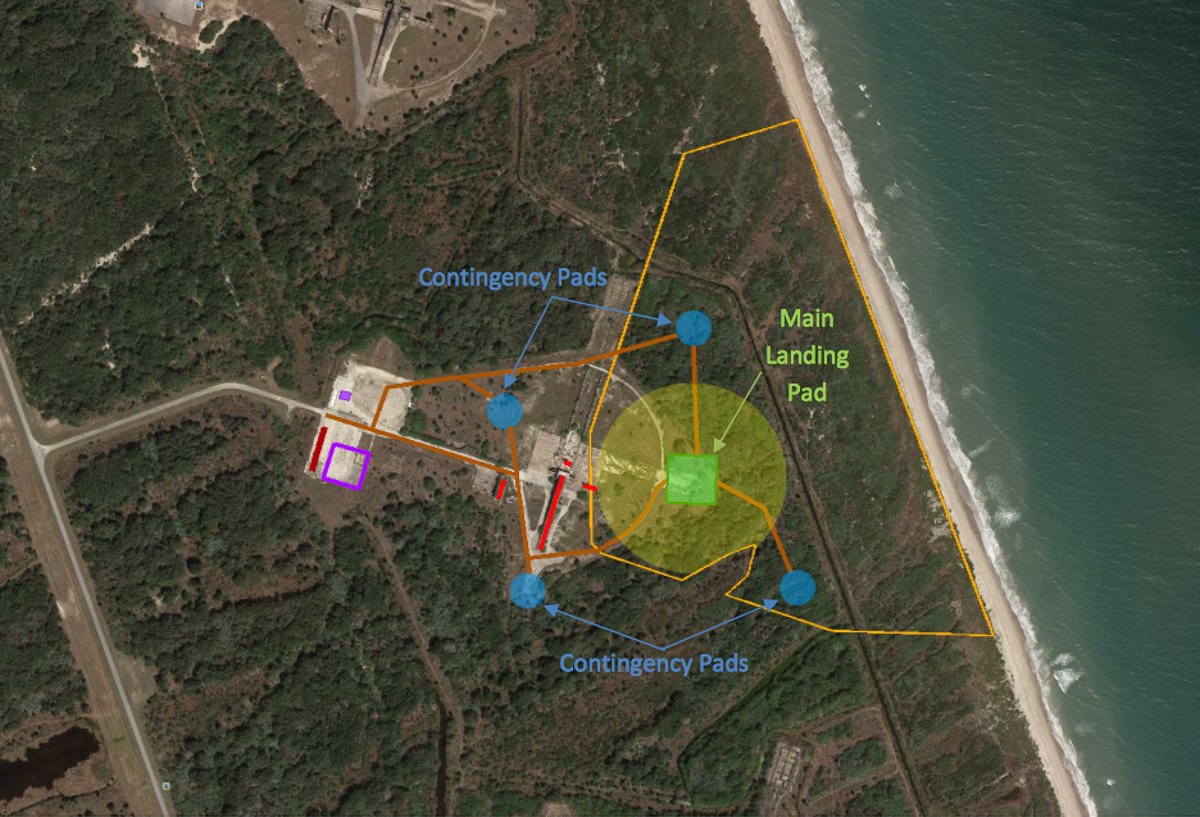
– Any flat chunk of cement is a landing spot. That means more places to land in case of contingencies. For yesterday's mission, SpaceX had one primary and four alternate landing zones.[1]
– I doubt industrial robots can withstand rocket exhaust. As helicopter footage shows, the landing pad got lit-up pretty good.[2] Remember, the first stage is over 40 meters tall. Those are some massive flames.
…and most importantly:
– Landing legs work on other planets.
1. Map: http://www.americaspace.com/wp-content/uploads/2015/12/LZ1.j... (from http://www.americaspace.com/?p=89910)
Parachutes, "catching" devices, etc. etc.
It all comes down to one thing, and one thing only.
Whatever the solution, it has to work on other planets with no infrastructure on that planet, and it has to leave the booster in a state that it's ready to go again with only a fuel fill up.
(No flight deck required -- just cables suspended between two towers and an arrester hook at the top of the rocket -- which just has to be lighter than folding legs at the bottom).
Also the empty rocket might be too weak to be grabbed by anything. They compare the thickness to a tin can.
"The reason they are floating around is that they have no net acceleration. The outward acceleration of (apparent) circular motion, which wants to sling them out into deep space, exactly balances the inward acceleration of gravity that wants to pull them down to Earth."
There is no "outward acceleration". The weightlessness is because the craft they are in is accelerating towards Earth with exactly the same acceleration. The reason they don't hit the ground is that they have a suitably high tangential velocity.
Since the frame where the center of the rocket is stationary is a non-inertial frame, Newton's law doesn't apply [1]. However a modification of Newton's law that includes a so-called "ficticious force" applies [2] (I don't think this modification has a name). This is why the article says there's an outward acceleration, because in the frame where the center of the rocket is stationary, the outward acceleration is caused by the ficticious force.
[1]: https://en.wikipedia.org/wiki/Newton%27s_laws_of_motion begins the laws with "when viewed in an inertial reference frame"
[2]: https://en.wikipedia.org/wiki/Non-inertial_reference_frame quotes, "One might say that F = ma holds in any coordinate system provided the term 'force' is redefined to include the so-called 'reversed effective forces' or 'inertia forces'."
1) The whole original post appears to be worded for the layman to try and dispel myths around what orbit is. I don't think the layman is going to think about inertial frames of reference, rather I genuinely think the common misconception that there's really something 'pulling' the astronauts up will continue, much like many people think a car is throwing them out of a bend in the road, rather than the vehicle pushing them away from a straight line.
2) In any case, even if Musk implies the frame of reference, there's a reason a 'centrifugal force' is also referred to as a 'fictitious force' [1]
Secondly, an acceleration on a mass requires a force. Supposing there were an 'outward acceleration', where do you propose the 'outward force' is?
It is important to note that the amount of energy needed to achieve a given velocity increases with the square, so going from 1000 km/h to 2000 km/h takes four times as much energy as going from 0 km/h to 1000 km/h, not twice as much.
Three times, not four--you already spent a quarter of the energy getting to 1000 km/h. Getting the rest of the way to 2000 km/h takes the remaining three quarters.
Elon is calling that four times as much as because he's considering the total energy required to accelerate from 0 in both numbers. I think you're just accounting for it differently by saying it takes 3 times as much as the original energy input to go from 1000km/h to 2000km/h.
I'm a complete physics novice, I'm open to being schooled on this if I'm completely missing both yours and Elon's concepts here.
edit: just saw this at the bottom and it made me smile; "Apologies for any typos in the above."
Aerospace engineers traditionally uses knots, thousands of feet and nautical miles. SI units typically have km/s (not /h).
I'd like to meet the person that is both uneducated enough to think that gravity suddenly stops and after that is "zero g", and also undestands what "proportionate to the square of the distance" means!
Edit: Just got to the end and saw this was prior to launch, so before Bezos' "welcome to the club" tweet. I guess in that context it's a bit more subtle at least, but still seems like he was making a point of the difference from Blue Origin.