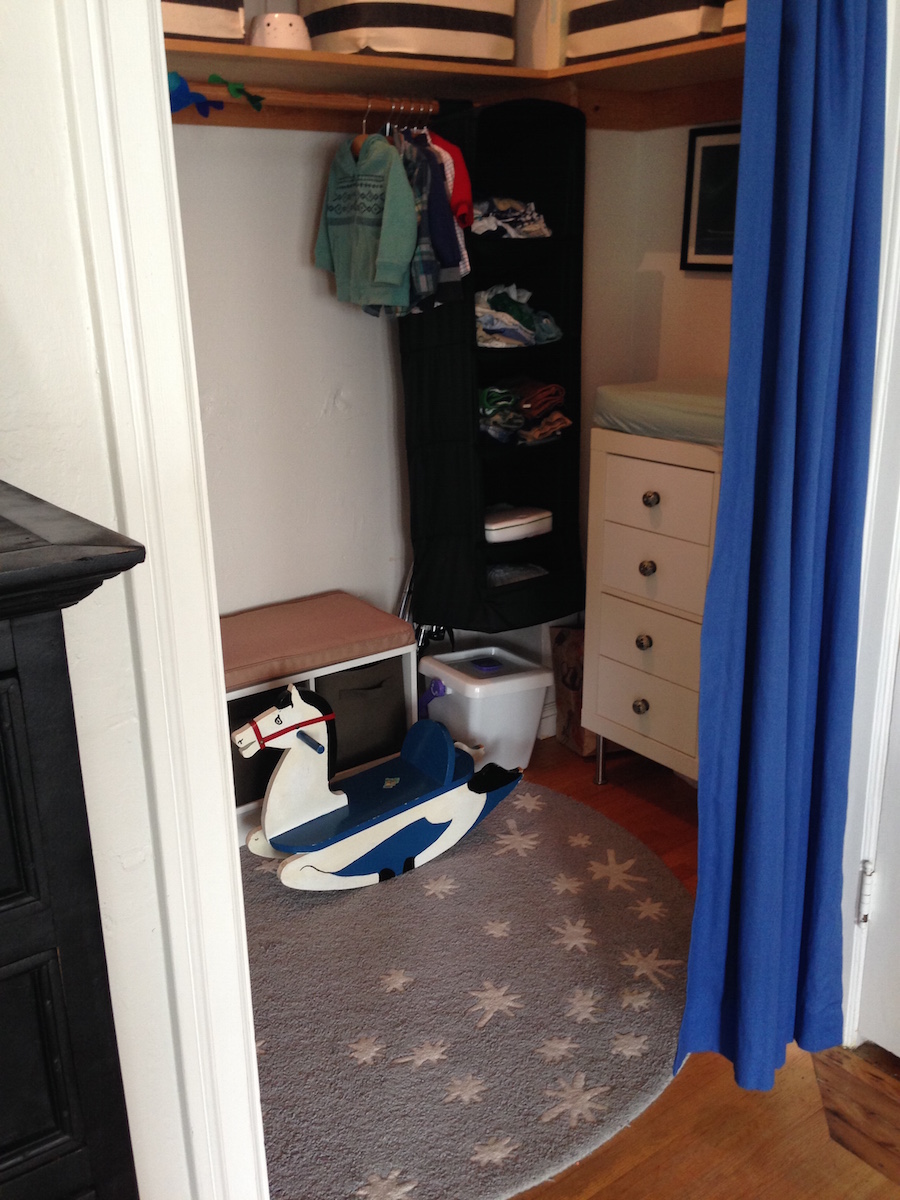
That article has a black board with a tally of diapers changed today. The count was up to thirty. Is that somewhat accurate/possible???
If so, holy shit, I'm investing in cloth....
My main comment, though, is that modern diaper technology is the bomb and you should definitely not go for cloth.
1. strips that change color so you can see with a glance from across the room if they need a change (if baby just wearing a diaper)
2. the wicking effect and absorbent substance in the diaper really do keep the baby's skin dry, even when they pee their diaper (not 100% but way better than cloth)
3. baffles around the thigh made of various materials prevent leakage in ways washable diapers cannot
4. well-designed diapers are super easy to put on, and more importantly, to take off and convert into a sealed bundle of mess -- they have integrated tape fasters not only to keep the diaper on the baby, but also to fold it up into a little kind of poo burrito, fastened with tape
But all those features are just minor differentiators, what you are fundamentally paying for when you buy disposable diapers is "not having to store and deal with a mountain of small towels with human feces on them". It's way, way worth it.
Here in Tokyo I pay about ¥13 per diaper, delivered by Amazon. It works out to about USD $40-60 per month per kid in diapers.
The only argument for cloth diapers is perhaps the pollution one, although I have heard (and want to believe) that the energy consumed and detergent pollution makes the difference insignificant.
Still, you are committing bag after bag of plastic into the landfill with disposables. But... if I had to improve my "eco" rating, disposable diapers would probably be the very last thing I looked at. You will have so many things to deal with when your baby is born -- anything that makes that easier is worth it and disposable diapers help several times every day.
Diaper pro tip: very young babies (first few months) require a "5-minute rule" on changing poo diapers. You see them doing it, or smell it, wait 5 minutes to change it. It's very likely it'll be a 2-stage operation, and if you change it too early you'll waste a diaper when wave 2 hits right after you're done (after if you're lucky). They can live with it for a few minutes.
Congrats, and good luck. The first ~6-9 months are fairly bad (mostly because it's a lot of work and kids just aren't that much fun at that age) but when they start doing stuff it's awesome.
One less important thing, we used cloth some too, for pee it is great. If/when your baby poops reliably, you can save a lot by using cloth during pee times of day and disposable when poops occur.
Diaper Genie
Incidentally, this is the first time since the change that I miss having the upvote score on an item.
http://www.nhs.uk/conditions/pregnancy-and-baby/pages/nappie...
> Some babies have very delicate skin and need changing as soon as they wet themselves, otherwise their skin becomes sore and red. Other babies can wait to be changed until before or after every feed.
> All babies need changing as soon as possible when they've done a poo (stool) to prevent nappy rash.
> Young babies need changing as many as 10 or 12 times a day; older babies at least six to eight times.
The UK NHS has a bunch of information about pregnancy and newborn children. You might want to find a site that you trust because you will get a lot of unsolicited advice from friends and relatives and a lot of it will be bogus.
(Congratulations, btw!)
By the time they hit six months it is less frequent, then after a year you may only have 3-6 diapers a day.
Remember with cloth that you have to scrape the poop into the toilet, you can't just toss it in a bag and have a service come pick it up (in which case you aren't saving money anyway).
I'm as environmentally conscious as anyone but disposable diapers are one of the few luxuries I choose to enjoy and I don't regret it for even a second.
That said, 30 seems high to me. Our kid probably peaked at about 8/day.
(We started with cloth diapers, but the amount of time washing them was just too high.)
And yet, clearly, plenty of people do choose to live in San Francisco.
It's simply where the most opportunities are. The idea is to move there and live uncomfortably until you network your way to an awesome, high paying job.
Alternatively, the tech companies there usually do more interesting stuff than in other area. Here in NYC most are related to advertising or media—stuff not easy to get exited about. San Francisco has its large share of silly ideas for companies, but it also has many that do interesting stuff.
I could easily live somewhere cheap and commute for a few years then build up enough to move somewhere nicer.
What irritates me the most is there is absolutely no physical reason why London has to be the place for start ups in the UK and a whole bunch of reasons why it's not a good place.
Where I live now rent and house prices are incredibly cheap (even compared to most parts of the UK), the city is rolling out excellent fibre (I have 150Mbps at home and 100Mbps at work) and transport links are excellent, it would be a good place to start a software company (I am doing) but hiring is going to be hard since it will require relocation to get the talent needed (or working entirely remote, something I'm considering).
Well, he didn't choose to live in San Francisco for long. By the end of his four years there, he decamped to Seattle, which seems to be the natural progression these days: live in SF and close a few deals in a tiny space, then move to Seattle into a slightly larger place and be amazed at all of the room you have.
Even if I lived in SF I'd be reluctant to commute an hour to work if I could just as well work from home.
> And don’t forget about the importance of compound interest. I will remind you that $2k per month saved on rent for one year is $24k. Invested for 50 years averaging 6% interest comes to roughly $450k. Freedom. HTFU.
$450K towards retirement for one year of living in cramped, expensive SF sounds like it could be a reasonable payoff for many people.
It definitely costs my startup employer (and myself), especially factoring in preschool. It also steals a job and "juice" from the local economy - we'd have already hired a nanny if rents were merely 2x a normal city, and we'd happily spend more buying from local craftspeople. The money goes into my landlord's retirement account basically doing nothing.
Is your landlord's retirement account a sack under his bed? If not, that money is being invested in publicly traded companies or in bonds to fund public works. It is creating jobs, just not in your neighborhood.
They can afford to live anywhere they want and start their company near their homes.
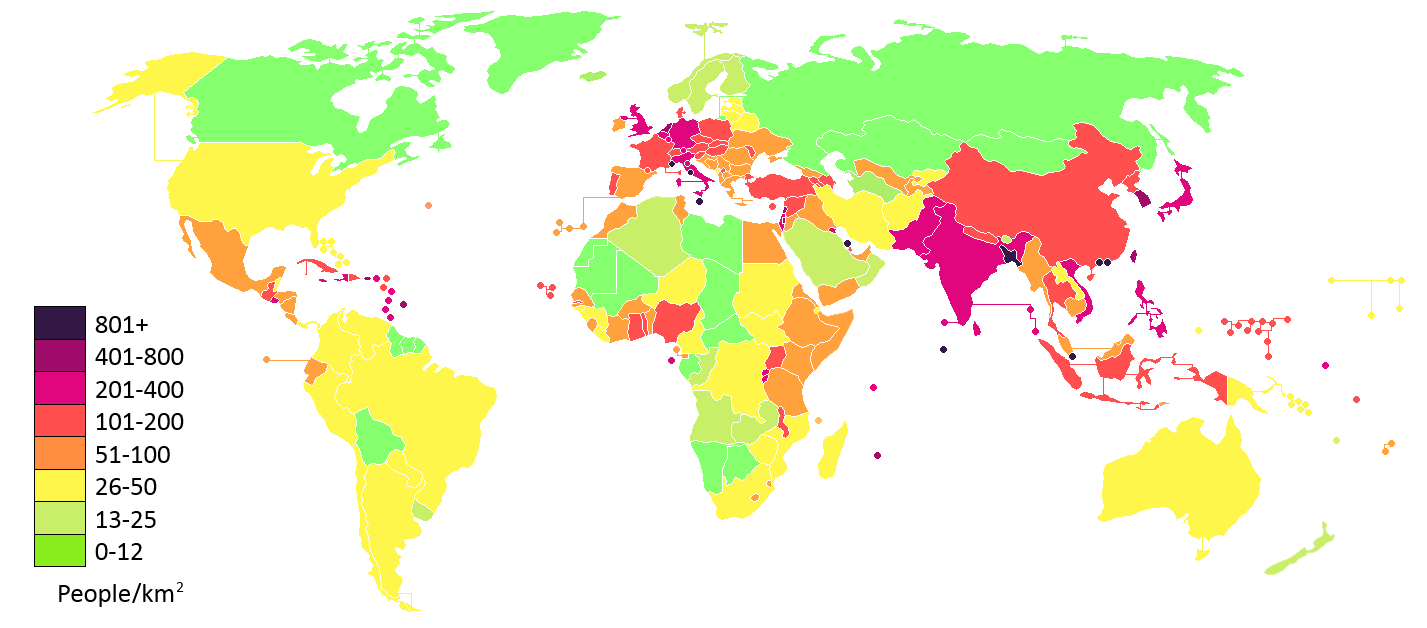
Netherlands is number 30. Admittedly most of the others are a lot smaller, but Bangladesh and South Korea are a lot bigger.
San Fran is also denser than the Netherlands, and AFAICS denser than any Dutch city (comparable with The Hague).
http://www.xpat.nl/product/holland-handbook-2015-2016/
Perhaps they taking other factors into account by excluding city-states like Singapore, Hong Kong, etc.
Seoul is 17,000/km^2. But living spaces are surprisingly reasonable, even by American standards.
It always blows me away that Paris has a density of 21,000/km^2, but the living spaces I've seen are pretty bad.
Like the article says, it just makes very poor use of its space.
Beyond that, I always wonder about population density figures, afaik there is no standardised process for these calculations. You may think 'well it doesn't get much simpler than population within certain area over that total area', but when making comparisons, the statistics can be deceiving, especially as a proxy for 'living space'.
For example, I live in Amsterdam and we have quite a bit of water (from the Amstel river that divides the city east-west, the Ij river that divides the city north-south, or the Slooterpas lake that's more than a mile wide to the many different canals), as well as numerous sizeable public parks including just one of them, the Amsterdamse Bos, that's 3x (!) the size of Central Park... And if you're not familiar with Amsterdam, it's a tiny city with less than a million inhabitants. When you're outside you won't feel cramped, there's a lot of public areas, it's open, it's quite nice. But that doesn't mean that the density of actual residential space is like that. Especially when you consider that most of the Netherlands, including much of Amsterdam (a city mostly built in a swamp area!) has relatively low buildings and little vertical space as opposed to say Taipei.
Further, you may say the Netherlands is only nr 30, but there are only 4 countries with more than 10m people which are denser of which only 2 are developed countries. The US for context is number 177.
So the Netherlands is quite dense per total area for one. Secondly, vertical space is quite low, and thirdly many of its cities have large open areas (e.g. parks, bodies of waters, like Amsterdam) has ample open-areas where nobody actually lives. So while population density numbers are interesting to measure density, they can't simply be used a proxy for measuring density of housing space.
A better look would be at floor space per person. It's hard to find internationally comprehensive numbers for local areas, but take Germany and France. Germany has about twice the population density, but the floor space per person is pretty much exactly the same. Pop density would've been a terrible proxy for comparing floor area per person between these two countries.
Another example is Ireland and the Netherlands. The latter has 6x the population density. But floor space per person according to this source [2] is larger for Ireland. That's a striking difference that completely blows the popdensity statistic to irrelevance if a comparison between these countries was made for space in the home to live, even if the numbers are adjusted for errors.
I see pop density references pop up all the time in online discussions and it strikes me as a pretty bad statistic to pick for most arguments in such discussions. This particular discussion is about OP's tiny amount of floor space in his home, a popdensity stat includes much more and it may not be applicable when trying to make international comparisons.
[0] https://upload.wikimedia.org/wikipedia/commons/thumb/6/67/Wo...
[1] https://upload.wikimedia.org/wikipedia/commons/4/4d/World_po...
is over 50% larger than the one in the article?
It's the difference between a studio and a nice one bedroom, or maybe even cramped 2 bedroom.
The new houses being built have 4 stories. Footprints are around 13x6.
In the UK in a similar town the footprint is easily twice that but the actual livable space is often less.
I know this seems like tedious legal nitpicking and the main apartment room is right there and "everybody does it", but nearly every line of fire and building code exists because of a preventable tragedy. Even if it's not against the lease it's unsafe. (And he built a barely-braced lofted bed in an earthquake zone!?)
The author happily compounded the rent they saved every month but failed to compound the increased risks they took every night.
To be a bedroom it has to have a window, a certain size (which varies), and some places even require a closet in the room.
If they find a bed in a room like that they normally start with a warning, then a visit from child protection services, or even condemning the entire house.
Obviously if they don't inspect they'll never know, but rentals, and people with contact with authority (CPS, Police, etc) could expect an inspection.
If you own, I'm not sure if the fire department can legally enter a home for an inspection without a warrant, but for a rental I believe they can, and do!
How does it compare to the risks of alternative courses of action such as moving to a neighborhood with a higher crime rate, tolerating an increased commute (hours of life directly lost, increased risk of road accidents, increased chronic stress with accompanying health risks) or moving to a different city before having a replacement job lined up?
http://www.gregkroleski.com/wp-content/uploads/2015/10/studi...
You should clarify that in Russia they operate in "living space" sq.meters, meaning that 400 sqft will not include kitchen, corridors, bathroom, etc. Just the bedrooms and the living room.
Secondly, you are over-generalizing. While a part of population did in fact live in cramped conditions (or even in shared condos, whereby 2+ families shared a single apartment), more than enough people lived in a very decently spaced apartments, with living space ranging between 28 sqm to 40-50 sqm. So "400 sqft" apartments were nowhere close to being "luxury".
OTOH, a bathroom with a window - now that was indeed a true luxury (because how the vast majority of buildings where designed).
We definitely had company over, often gatherings of 10-12 people and one time we had 5 overnight guests (that was a bit crazy but fun).
Also, in the sentence about the coffee table (seen two photos up), shouldn't that be "second photo from the top"? Unless I misunderstood and tried to find a coffee table in the photo with the surfboards/piano
My parents went through it in 80s. By then this mostly worked for military/otherwise connected families, but has broken down for the rest of the country with wait list numbering in years. In theory you gave up smaller apartment for a slightly larger as need arose. In practice, most families did not want to move far and construction pace did not keep up for economic reasons.
EDIT: typo, I meant sqf and not sqm.
400 square feet (~37 m^2)
No need to turn this into another stereotyping Europe vs US issue. I agree 37 m^2 is plenty of room for some people, not for others, regardless of where you are from.
But it is kind of true that Americans are extremely melodramatic about this stuff. 800 sqft house is often referred as a "tiny house" in American media. In the UK (for example) this is an average house size.
You mean 40 m^2 ? 400 m^2 is a big house :D In that case I can agree - in my country (Croatia) ~40-60 m^2 is the norm for family apartment. Also interesting - huge apartments (>100 m^2) are nowhere near to being proportionally expensive (except on the top end) because people can't afford them - eg. they might be double in size but only 1/2 more in price.
People need their space while it's true that there might be some "romantic" aspects to small housing the disadvantages are quite noticeable there are plenty of adverse physical and mental health effects when you live in smaller spaces, from asthma to mental stress and social friction that can increase the likelihood of divorces and breakups.
I live with my GF for 6 years and I would never ever live in an apartment with less than 2 bedrooms, people need their space, if you have a fight it's good to have a place to go and just cool down and not continuously get annoyed at the person, having a guest bedroom/office is also quite good for that time where you under allot of stress at work or just having a bad day and need to finish some things without being disturbed.
And while It's perfectly fine to say to your partner "look, I'm having a rough day and I need to be alone" it's just much better when you don't have too, when you know you can sit down some where and just relax.
Having larger space also gives people privacy which even in a relationship is very important if the 2nd bedroom door is closed my GF knows to knock, if our bedroom door is closed I know to knock. And before some one makes jokes about it no we don't expect to catch one of us with the mailperson in there but she might be having a private call with her parents or doctor, she might be planning a surprise and i can do the same.
And while you can do those things even without having an extra room by juggling your schedule the fact that you don't need too adds quite a bit of relief, I've seen other couples having issues while living in small apartments from having to lock yourself in the bathroom after a fight to having to make personal calls from it or worse have to say "hon, I need to make a call so I'm going out for a few" which is just uncomfortable for both people because even in a trusting relationship having a private call inside the house gives the added assurance that it's probably not that, while when you need to go out to make it there might be some fears gowning at your partner even if they are completely subconscious they are still there.
People need their space,calling it a luxury and that people in "Insert European, 2nd world, 3rd world country here" are living in small spaces is not true, because in many of them the overall living space tends to be much much bigger than what people would imagine, especially when you count in communal and open spaces.
Not even Hollywood is like that. People may stay in trailers for some time but that's it
As personally having to live in a tiny place (not in SF though) it is not something I want to do for an extended period of time, even though the advantages like 'city living' are good
Because it's their choice.
Right now the housing market in San Fran is redic. However, there are other major tech areas that don't nearly have the same problems.
A) establish themselves in such an uncomfortable location
B) not embrace distributed teams
It's a terrible cycle at this point.
I think you making a pretty broad leap here... This is entirely his choice, and nobody is "making" them live in a confined space - most of my friends that are starting a family leave San Francisco and move to the suburbs to get more space at a lower cost (e.g., San Mateo) and take BART to get to their job in San Francisco.
Isn't tech approach the same? You wait for your big break and then move out.
I wish I could say we have kept this up now we are back living in the "real world" but some of the spirit has rubbed off and we're definitely much better at becoming less attached to particular belongings.
I strongly believe that most belongings end up becoming burdens if you don't establish a process of questioning their utility on a somewhat regular basis.
Thanks for the article! Really thought-provoking.
Basically, if you live where all of the minimum-wage people live, you're going to get spill-over from all the typical problems in such a neighbourhood.
In an age of high-speed internet, it's ridiculous that we insist software engineers be jammed into dense, expensive globs. Working remotely with Skype calls/IM/screensharing is a better experience, all around, than trying to collaborate in the same office, at least in my experience. You do have to have employees that will actually work, though.
I think you fail to see that he'd definitely describe his living over the past few years as 'decent', and likely even much more than just decent.
In SF, NYC (where I live) and other US localities, the issue is not family income but rather is the use of politics to limit zoning density and thus artificially creating housing scarcity.
Thus, renters pay more than they otherwise would with an efficient market and billionaire land-owners have much greater wealth than they would in an efficient market.
In NYC, we had a somewhat similar situation with Taxis. Medallions were artificially limited to 13,000 in this city of 8 million where many people do not own cars and use mass transit and taxis. As a result of this 13,000 limit, taxi medallions had a market value of $1.2 million.
Then thankfully, Uber came along, thus creating a larger supply of hail-able taxis and the taxis medallions now have a market value of $700,000 or so and some taxis are no longer in use.
In NYC, our current mayor has two properties that he rents out for a total of $120,000 per year. He is able to get this high rent because of city laws that limit zoning density. Thus, he has every incentive to want to artificially limit zoning densities.
Thus, while many liberals fret over income-inequality, they still support zoning regulations in cities such as SF and NYC that amount to a transfer of wealth from lower income individuals to wealthy individuals.
There are not typically 10 children at once in the home BTW. The older children will be away at school, around 14 for boys, 17 for girls.
What you do is have 3 bedrooms: parents, boys, and girls. Depending on the boy/girl ratio you can have up to 2 triple-bunk-beds in a room.
Doing that you can easily sleep 12 children in the house (if you had to).
There is no living room, instead there is a dining room with a huge table (large enough to seat everyone at once) that doubles as a multi-purpose room for homework, and other activities.
Children are encouraged to play outside (there's hardly room inside).
For possessions there is not usually a need to store much since you'll pass things on to other people, your children, relatives, friends, neighbors, etc. and they with you, so most items are in active use. (For example, once the kids are older and you don't need a triple-bunk-bed you pass it on to someone else.)
This also means you don't need to spend as much as you might expect on stuff. If you don't have a lot of money you can go your entire life without once buying new clothes, or other gear for the kids.
That said, I am looking forward to moving away from the Bay someday to more space. : )
The compromise is that the stuff they sell that has significant decorative elements is extremely flimsy. The malm series is probably the most durable furniture they sell, because it's just 3/4 inch or 1 inch osb sheeting that's cut and joined in different configurations with bolts.
Anyway, it's a really good read and not at all what I was expecting. I am sort of disappointed that so many of the comments here are about "Boo -- small space living!" or "Ugh! San Francisco!" or "It's even worse in many other countries!" because the piece really was not written that way. It wasn't written as "Ugh! Pity me! Boo hoo!" It is very thoughtful and a really good read.
I just wish the article had a native tweet button. I couldn't find one.
In our case, we put one up over the middle of our bed, and hung all our clothes on it (even hanging-optional stuff like T-shirts). You had to kind of tunnel through it when getting into bed, but this let us make use of the otherwise useless airspace over our bed. It also formed a kind of soft wall or curtain that made the area where your head was darker than the rest of the main room. That was handy when one person wanted to sleep and the other was still working.
I thought the direct lessons he laid out were excellent, about being ruthlessly honest on what you truly need to be happy, and the freedom that you get from the resulting wealth when combining that with a SF tech salary.
It is a reasoning from first principles on living conditions that not enough people do imo. I think we tend to subconsciously accept the default of more space/stuff=better without making a direct choice on what is the specific right amount for ourselves. Coming to a definition of what "enough" is for ourselves keeps the goalposts from moving as income rises.
Also the point about gaining empathy for the poor based on experiencing a lower margin for error and high cost when things went wrong in this lifestyle was another good observation.
I'm only making the change I am now because it's actually closer to the job I started a couple months ago, and I'm hoping in the next 18 months to have my credit clear (still paying off medical bills from 5-6 years ago), my car is paid off in 14 months, and want to have enough for a down payment for a house.
It's hard for me to imagine living in SF, where rent is significantly more than I pay now, and the pay doesn't quite correlate.
I had discovered that excellent wisdom independently when setting up my various college dorm rooms.
He later says that he is "forever changed" by the experience. I hope so. Myself, I had forgotten, and I thank him for the reminder.
If you can do 50 miles when the hail is coming in sideways and it's dark and your on a hill in the middle of nowhere then everything else seems easier.
http://www.section8facts.com/2014/10/23/section-8-guidelines...