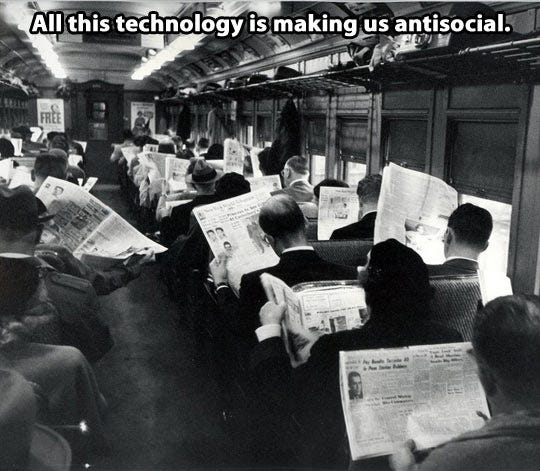
Right there is where the author looses me. That online collaboration via the phone IS a social gathering unto itself. One is not fundamentally different than the other. Physical proximity is great, but it is a serious limitation. Not everyone has the time/money to physically meet their friends over coffee every twenty minutes. Not everyone lives in downtown Boston or NY.
> They say it’s a skill they mastered in middle school when they wanted to text in class without getting caught.
And why do kids text so much at school? Because they are bored to death by mind-numbing subjects and teaching that doesn't actually teach. Texting is the symptom, not the disease.
The ability to 'not get caught' while communicating with others is a valuable skill for nearly everyone these days. It should be encouraged.
Still the fact is that it is inconsiderate, or plain rude, to be "somewhere else" when you are sitting with other people who all took the time to physically be with each other. If a few people get together and spend large amounts of their time on their phones, then why get together at all?
>After five days without phones or tablets, these campers were able to read facial emotions and correctly identify the emotions of actors in videotaped scenes significantly better than a control group.
Why do you care how other people enjoy themselves?
Actually there is plenty of evidence that texting and social media offer a similar kick as several other addictions like smoking, etc. it's akin to blaming teenage smoking on boring classes. Further, the teenage mind is susceptible to getting easily bored and to addiction.
I'm sure one could just as easily say that getting the mail is like other addictions, because I chronically get excited at the thought of my latest online order arriving.
Habitual behavior in general forms because of "a similar kick". The main difference between a habit and an addiction is whether the habit is seen as adaptive or maladaptive.
By all means, communicate with your friends over the internet using all the means availed to you by technology. On the other hand, when you're sitting at a coffeeshop with your friend right next to you, that isn't the time to be chatting with someone half way across the country.
You seem to have missed a main theme of the article, which was in first paragraph: "Now they use it when they want to be both with their friends and, as some put it, 'elsewhere.'"
I would say an illusion of financial security does that too. If your life depended on getting a decent education, petty indulgences like this wouldn't even occur.
Personally, i've been following the maxim "Prefer a warm body over a cold screen." I turn off (most) notifications. Sure, sometimes i'll pull out my phone to look something up. I'll check from time to time if i'm coordinating with someone, but i try to let my interlocutor know what's going on.
If you always optimize your attention towards whatever is most immediately compelling, you'll wake up one day and find out you don't really know anything.
As the article says, it takes more than 30 second to divine whether or not a conversation is going to go somewhere interesting, and if you stop paying attention at the drop of a hat, it never has a chance.
I think that's an older-generation thing. If you go 30 seconds without getting to the point, of course people will think that you don't have one.
I don't think that valuing relationships by how useful they are to you "right at this moment" is a very good way to go about life.
One of the rudest behavior I encounter is people suddenly coming to you and interrupting in the middle of your IM conversation, demanding undivided attention and refusing to accept that you're in the middle of a conversation. IM is not e-mail, it's often as time-sensitive as voice, and quite often that IM conversation is much more important than whatever the interrupter came with.
It's also natural for some to follow new trends for there's a lot of energy in exploring things 'a la mode'. But also not to be blinded into thinking old is useless. Progress is not an arrow, it's a wiggling hyperplane.
I don't particularly care about other people's behavior (and I don't have this problem with friends/family), but I can certainly see how it would annoy people, and probably even detract from the experience of the person who is doing it.
It could be different, but its not. These phones are brick walls, carefully channeling the minds of the enslaved back to the master.
So I started thinking about what I would do to make it different, and really, I think one small tweak to our technology would make a huge difference. Of course, its not in the interests of the manufacturers or network providers: make it possible for phones to auto-discover each other locally, without requiring a server somewhere upstream.
If only we had some way to get people connected to each other - in a local context - i.e. anyone on the train can search for and find others on the same train without requiring a client-server relationship with an upstream connection. Host-AP mode: too restrictive.
We need local peer search and discovery.
About the only way I can think of to get this right now is to man up and put a device in AP mode with some sort of SSID named "LocalUsersNetwork" or something .. some sort of recognizable brand that people can use to connect with their local peers.
It would make the forward march towards further electronic enslavement so much more palatable if it were possible to have at least a local context in which to freely operate.
EDIT: events like this make me think there is a market for "local stranger discovery services", its just nobody has worked out a branding process for it:
[0] https://d262ilb51hltx0.cloudfront.net/max/800/1*U36hBj8i-C7J...
If somebody would have said a few decades ago that in 2000, every employee would have a television set on his desk, people would not have believed this person. However, the situation is actually much worse.
I am nostalgic for the land before internet. While there are many technological divides and revolutions between generations, not sure many in history compare to the dramatic change to global society and behavior as a result of the internet, and by its extension, the mobile era.
The way we look at the changes is much more tied to us than the change. You can always flip a coin and think of how marvelous these changes might seem to people in the past: "While I'm sitting in cafe with someone I can simultaneously communicate with someone else half-way across the globe? Wonderful!"
People seem to have forgotten that before the rise of the Internet there was another form of media that dominated our lives, and that was TV. Some of the complaints that apply to the Internet also apply to TV, in that it directed our attention away from life in our immediate vicinity, dominated how we spent our free time, etc...
Even though I basically only watch YouTube now, I remember watching a ton of TV in the 80s and 90s. I have some fond memories of moments spent watching TV, but for the most part I watched a lot of utter dross. The same is true for the Internet now, some fond memories of time spent online but something keeps me looking even when the content is dull.
If I could go back, I'd go back to an alternative reality where pirate radio was the dominant form of mass media. I like radio, and I'd like it even better with a greater variety of output, including easy to find output from those in the local area.
Friends say "but it was [such-and-such nonsense]. I had to check my phone!" Really, you had to? Your life depended on you checking that text? People get frustrated with me because my phone is dead all the time (and thus I don't text back immediately), but I hate feeling tethered to some device.
I notice an overwhelmingly huge difference in the quality of my conversations with people when their phone is not present in the room with them.
This isn't to say I'm anti-technology at all — I spend 10 hours a day programming. I just don't attempt to do it while conversing at the same time (nor could I; without uninterrupted focus, I make a lot of mistakes in my code).
In my experience, they haven't mastered that nearly as well as they think...
The article has a great message, but unfortunately I don't think most people are conscientious enough to deliberately change how they use technology and it is just so easy to check your phone when there is a lull in a conversation. Technology has been beneficial in many ways, but it has a tendency to be incredibly antisocial as well and I don't think we've learned to compensate for that yet.
This screams of a lack of mindfulness that hopefully can be fixed through working to become more aware of your own thoughts.
By far the most distracted people on the team are the older ones. In meetings they tend to lose focus, look at their computers, misremembered what's said, or just seem to tune it out. I've made a habit of specifically managing how they are perceiving what I'm saying -- looking at their eyes, seeing if they're distracted, asking lots of confirming questions.
And outside of meetings, they don't pay attention to our online communication channels enough.
If anything, my experience has been that it's the older generation that sucks at paying attention to the right things in the new super connected world.
(I was going to use that Socrates quote about "Our youth now love luxury. They have bad manners, contempt for authority" but it turns out not be by Socrates but from someone in 1907 paraphrasing complains from antiquity http://quoteinvestigator.com/2010/05/01/misbehaving-children... )
We're in a golden age of text, with dramatically higher engagement due to an unprecedented access to more useful, interesting and relevant information than has ever been available before.
The title uses a new fancy word, but it might as well say "Stop reading. Let's talk."
Your smartphone represents almost everyone you know. In a face-to-face meeting, the ratio is precisely (n-1)/n. So if you both have 100 friends, realize that you're competing to meet the need of love and belonging against the 99 other people in their pocket, who can also give that to your friend with surprising effectiveness.
(The argument generalizes: you are also competing against every stranger that's ever put anything online - the person who wrote that Wikipedia article or Yelp review has a call on your attention, too!)
I'm curious: Does anyone have rules at work around no laptops / phones at meetings?