> The plural of anecdote is not data.
Ah, but it is. It's biased, hard to analyse, fraught with many perils… but it is still relevant information. Even though anecdotes are rarely conclusive, They can often tell you where you should look next.
This is similar to the correlation/causation thing. Sure, correlation doesn't imply causation. But it sure makes it much more probable.
Simply having "plural" is not enough. You need a well-designed experiment, with well-controlled variables, good methods and measurements, good consistent recording, and enough points of that nature to show significance. And all that without natural biases, such as the confirmation bias so common with anecdotes. You can have as many self-reported stories from a self-selecting population as you like and it still won't be good data, due to the inherent bias in the method.
It's difficult to recognize these biases, which is why we say "the plural of anecdote is not data." Not because some data isn't a series of anecdotal points, but because good data is often so much more, and it's important to respect that. Sure, use it to guide your instincts, but don't mistake it for rigorous science.
Further, a collection of many anecdotes is not necessarily great data, but the quality of data can be taken into account when making assertions about it, and you can attach confidence ratings to assertions made based on data with known faults.
The problem here is that "the plural of anecdote isn't data" is just a short, snappy thing to say, that doesn't capture any of the nuances of what data is and how it's used. A lot of times it's used to express a legitimate point, but I think we could express that point more accurately by actually talking about what data is instead of oversimplifying the concern.
For the nice case of comparing two hypotheses, I'd rather talk about decibels of evidence: which hypothesis does it support, and how strongly does it support it. That way you don't even have to chose a null hypothesis. (You still have to work with some "priors", but in practice you have to assume things anyway).
> Sure, use it to guide your instincts, but don't mistake it for rigorous science.
"Rigorous science" is the easy part. It's the point where you already have some insight or theory in mind, and you just have to test it. But first, you need to get that insight, or formulate your theory. At that point, your instincts is pretty much all you have.
http://evidence-based-science.blogspot.ie/2009/11/plural-of-...
If it wasn't, where would data come from?
In fact, from my experience (haha), it seems that people use anecdotal evidence whenever it helps them or supports a popular opinion, but then demand stronger evidence when it goes against their current belief.
In actual fact, the authors had hoped the real value of their research would be in getting people to question themselves.
I.e. Instead of saying: "look at that dumb person, he doesn't know he's dumb."
The authors hoped people would say: "what if I'm not as smart as I think I am?"
I guess the "other people are dumb" meme is so much more comforting, though.
Self inquiry is, IMO, a cornerstone of self regulation. If you're asking questions you're already well on your way. If you're not you won't notice that self-help articles even apply to you. (In fact I think of most self-help advice is, at best, milestones that you can't recognize until you've gone past them. It can tell you how far you've gone and when you've made a wrong turn, but it doesn't actively help you get where you're going. It's all up to you).
Is that commonly true or ~always true?
I find myself on both sides, though more often catch myself in self-doubt than overconfidence.
I don't recall if I figured this out on my own or someone trained me but I do know this was about the time I started a process of metacognition, wherein my internal dialog became a deliberate process of repackaging the things the teacher was saying into something that made sense to me. Instead of trying to cram their mental model into my head, I would build my own hypotheses and test them against all the examples that were provided, then abandon them for a new one if they didn't fit. [Edit] And when I got the answer wrong I would halt the presses and try to figure out why I was wrong. I used to joke that if I wanted to remember something forever all I had to do was get it wrong on a quiz and it would stick in my brain for eternity.
Prior to that I assumed if the teacher said something that didn't make sense that I was stupid. After I assumed that the teacher was just speaking a foreign language and I needed an internal translator. I went from almost held back to honor roll in the space of about a year.
(this trick, incidentally, made me an exceedingly good troubleshooter in my professional life, and "If you can't figure it out go ask hinkley" is common strategy almost everywhere I've worked. Not only can I probably solve your problem but the mental tax is lower on my than it was on you, because it is my idiom to process facts this way. I am literally always thinking about thinking).
To put it another way, the less skilled practitioner is comparing what they know today versus ignorance. An experienced practitioner has been around long enough to have experienced tough problems that highlight the limits of their knowledge. In other words, one group is likely to compare themselves to an unskilled cohort and the other to a highly skilled one.
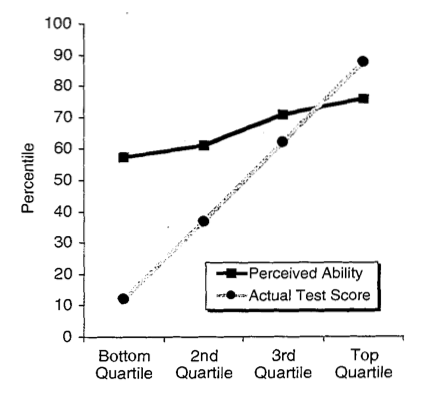
Excluding people who rate their ability at zero and who perform consistent with that ability skews the graph.
"So the bias is definitively not that incompetent people think they’re better than competent people. Rather, it’s that incompetent people think they’re much better than they actually are. But they typically still don’t think they’re quite as good as people who, you know, actually are good."
and graphic:
http://www.talyarkoni.org/blog/wp-content/uploads/2010/07/du...