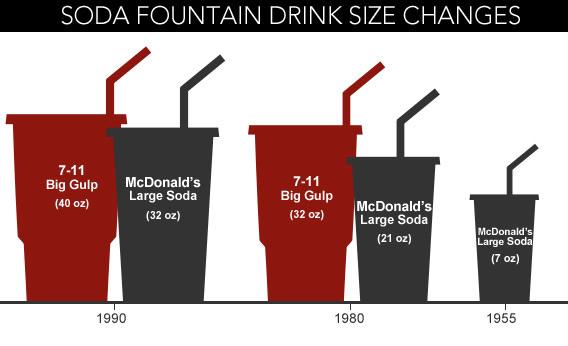
Really? I would love a source on this, because it seems that the #1 reason is that the average portion size has increased greatly in the past 30 years while people are exercising less and less.
It would be great if we could find a way to "flip a switch" to make weight-loss easier, but it's downright foolish to pretend that we are gaining weight for any other reason than that we are eating too much and exercising too little.
This "processed foods make you fat" nonsense is infuriating because it just validates people's beliefs that their weight problems have nothing to do with their personal habits, instead placing the blame on the quality of the foods they've been eating.
That's a good way to view any problem having to do with people. People are the same as they've always been--it's ludicrous to think that they're intrinsically any lazier or have less self-control than people a generation or two ago. If they're a lot fatter than prior generations, then something external must be different. You're never going to fix people, so if you want to solve the problem you have to focus on those external things.
I'd be perfectly content with a switch to flip, and have no guilt nor shame in flipping it.
Right, but the question here is why are we eating too much? (why we're exercising too little is easier to answer: it's harder to exercise when you're overweight, and our lifestyles have changed). It seems that the hunger mechanism is out of whack; either because the types of food have changed, or something changed in our internal reactions to calories/fat/etc
Right, that's pretty obvious to most observers, but it's not the end of the road. The interesting question is why this is happening. Is the cause purely social (perhaps we're lazier, or perhaps large portion sizes occur purely by normalisation over time), or are there other changes to our society or what we eat that make over-eating and under-exercising more common?
I agree with your statement: Portion size in North American markets is ridiculous; Our consumption and exercise levels are way out of whack and that surely does need correcting; But there does appear to be a not insignificant number of people where despite diet, exercise and unimaginable will-power and discipline, there is little if any change in body mass.
Some people despite eating ridiculous amounts of junk food their entire lives and doing little if any discernible exercise have a disproportionately low body weight; and some people despite eating little store all the fat their bodies can muster. I watch enough of this around me every day to know that these people aren't lying - if they could flip a switch to make their lives easier, why wouldn't/shouldn't they? I would. I know that even having the tine/discipline to lose 10-20lbs is hard. Imagine those that have 100+lbs to get into a healthy range. That's a struggle many of us will hopefully never have to comprehend.
The article is pretty clear in stating that this new research is novel because it might depose the firmly held belief that diet and exercise is the sole cause/determinant of one's obesity.
Eating garbage food is a personal habit, but the food is also engineered to be not very filling, high in calories, and mildly to strongly addictive (more profit!), so how do we balance personal responsibility in the face of adversaries engineering addiction?
instead placing the blame on the quality of the foods they've been eating.
Except, the food quality/provenance is the problem.
Go to middle america and watch obese people at restaurants. Most of them are ordering more obese-enabling foods. Giant sandwiches, giant cheese fries, giant cokes refilled three times per meal. A lot of people just don't have the training or education to connect what they eat to their physical body—bodies are magical things that "just exist" and "just happen" with no responsibility in any direction.
You can't get an obese person (100+ pounds overweight) down to "normal" just by exercising more and eating less of already addictive bad-for-you foods. You've got to remove all the crap from their diet and essentially de-program them from a lifetime of bad habits. Oh, and we need to do this on a national (even global) scale on the order of hundreds of millions of people.
First I'll agree with you that most people lack self control, and that the increase in portion sizes is a significant factor contributing to the obesity epidemic we're seeing right now.
That said, as someone who's been tangentially involved in product engineering for years, literally everything from the packaging to the chemical composition is designed the re-enforce addictive behavior (which is intrinsic to human psychology). Serving sizes are also often deceptive as they don't clearly indicate the macronutrient content for an entire package (as they do in many other countries). Sure, 7g of sugar per serving seems ok for cookies, until you realize that's every 2 in a box of 20 and you've eaten the whole thing (70g).
Most preservatives and artificial sweeteners are actually fairly inane, despite scary-looking ingredients lists. What you should be worried about are the cheap forms of sugar, refined carbohydrates, hydrolyzed oils/trans fats (which are thankfully declining in popularity), and HFCS/cane-sugar-based drinks which average 32-68g of sugar per bottle.
All of these things cause a condition called insulin resistance, which leads to obesity and eventually if untreated, acquired diabetes. Insulin is the hormone that extracts glucose (energy) from carbohydrates (food), and turns it into a source of energy for your cells. [It is well established scientifically that the aforementioned "watch-list" all spike your insulin levels, and that instability in your insulin levels relative to blood glucose is bad.](http://www.ncbi.nlm.nih.gov/pubmed/2995635)
In layman's terms, these things make your body release disproportionate amounts of insulin compared to the amount of food you've ingested, and this has a few downstream effects; a large spike can make you feel intensely hungry (why people say "empty" foods make you eat more than you would otherwise), and most importantly insulin becomes less effective at transporting glucose. That's the beginning sign of Insulin Resistance Syndrome, and its correlation to obesity is well established.
Ultimately it's because of the composition of processed foods, not any dangerous chemical additive (with a few notable exceptions) that most long-term complications arise.
Looking back 30 years you may be correct, but looking back 500 to pre-industrial diets, you'll notice sugar was less prevalent in the food of most Anthropocenes, and fiber was much more common. The sugar lobby of the 1900's is largely responsible for its GRAS status and current abundance.
These days we mill our grains into cereals, removing any traces of fiber/micronutrients and inject large amounts of liquid sugar into most beverages for 'flavor,' having the compound effect of up-regulating what we perceive to be "sweet." Both of these things make our bodies release far more insulin than is needed to extract their energy, making us hungrier disproportionally to caloric intake and setting the stage for a diabetic future.
To the unconscious consumer, these forces are silent and automatic. For as little self control as people may have, I personally can't place sole blame on the individual when I know the entire chain of supply to be rigged against their nutritional best interests.
I always assumed I wouldn't eat much sugar because I don't like sweets and I don't drink soda. But once I started counting added sugars in the processed foods I consumed it became clear I was consuming way too much of the stuff.
Nowadays I just watch out to buy products with 0 sugar in it. Now that's of course no silver bullet but a pretty low hanging fruit when it comes to improving your overall health.
21 libs down in 7 weeks. Blood pressure down a lot. Swelling down, energy up. Feeling better.
And yes I do exercise. Try to do 5 hours a week. Probably average 4.5 hrs / week.
It is frustrating that processors add sugar to virtually everything.
Some environmental factor could be behind all of it
http://rspb.royalsocietypublishing.org/content/278/1712/1626...
Stop eating bread (yes, pizza counts as bread. beer counts as bread. stop it). Stop drinking calories unless you're exercising for 2+ hours at once (yes, fruit juice is bad for you. stop it).
The practice of making "processed foods" is essentially just cramming carbs and salt into everything and making it as highly concentrated as possible. Much processed food (read: basically anything pre-packaged in a wrapper) is more like a high calorie MRE food brick instead of something you should be combining with other foodstuffs.
We know how food interacts with human bodies. Water doesn't cause fat growth. Dietary fat doesn't cause fat growth (the chemical 'fat' isn't human fat tissue, so drinking a gallon of olive oil won't increase your fat stores). High glycemic sugars cause fat growth in non-glycogen depleted bags of bones. Turns out we can stop getting obese just by not eating things causing obesity.
The only thing even remotely healthy about my diet is the vegan part.. but that makes me rely even more on the carb-heavy foods you attack.
I eat tons of processed wheat-based food every day.. I drink heavy juices by the liter, and I am still seriously underweight.
There is clearly a metabolic component, the control of which the OP was theorizing.
Since I've cut processed food and bread entirely out of my diet I've lost a lot of weight pretty effortlessly. I don't think this experience is unique. I also know people that can eat lots of these foods without weight gain.
http://www.slate.com/content/dam/slate/articles/news_and_pol...
There you go. We are eating more. As other nations adopt an American diet, they also eat more and get fatter.
There may be other things as well, but far too many people are looking for the magic pill that lets them eat all they want and not get fat.
Make sure you're eating a healthy diet and getting needed exercise, then you can move on. But god damn, act responsibly first.
That might be good for the health side of the crisis, but the graphs of obesity correspond with food waste as calculated by the NIH. Only 30% of the excess calories have gone to making us fat, the rest is waste, so solving the health side alone will not fix the economic or environmental sides of the issue. This issue is discussed in depth at the end of this video: https://www.youtube.com/watch?v=hPi1LQHBWBk
There is, it's called carbohydrates.
It's similar to thinking we have solved poverty. People living in poverty should spend less and make more. Problem solved.
The much more interesting questions are
1. Why does it take some people more food to reach the same level of satiety as others?
2. Why do some people's bodies burn off excess calories through things like non-exercise activity thermogenesis and other store it as fat?
3. Do different types of food effect long term satiety? By changing what we eat can we effect our weight in the long term?
4. How does the body increase hunger and turn off self-control when there is reduced food intake?
The only known "solutions" we currently have to obesity are dieting and exercise. The problem is the long term efficacy rate of dieting is around 5%. If dieting were a drug it would never pass FDA approval for effectiveness. Exercise has only modest effects and is probably more effective as preventing weight gain than causing weight loss.
We still have so much more to learn. We are just at the beginning of figuring out the causes and solutions to this issue.
Why is it completely unhelpful? The corollary is that if you adjust your intake to X (where X might have to be determined empirically for the individual), and use planning and your conscious brain to know when and what to eat, you _will_ lose weight.
This is a revelation to some people, who, once they realize the simplicity of it and plan around it, are able to completely change their bodies. Many of these same people try various intuitive plans that don't work for them (because they don't have the intuition) or try to manipulate exercise first (which makes some people increase appetite).
If you don't believe me that it works, is useful, and is a revelation, go lurk on the myfitnesspal forums for a while or /progresspics on reddit and read how people succeed.
People aren't fat because they eat too much. People (and mammals) eat too much because their fat cells are being metabolically triggered by environmental and/or genetic factors to store fat at a higher than normal rate, diverting calories from operational needs, thus stimulating hunger.
Bears don't go into hibernation because they've gotten fat. They get fat because their endocrine system begins gearing up for hibernation, and telling their fat cells to kick into overdrive growing. They will literally burn muscle while simultaneously gaining fat in this stage, like all hibernating mammals. The other side effect of growing fat cells is massive hunger, obviously.
In humans, simple things like not eating sugar can help correct the endocrine factors which, for a lot of people, cause the fat cells to do this. However, genetic factors are going to be a different story.
I say this as somebody who is fit and active, but have had running buddies who are fat. Pitting will-power against metabotically driven hunger ends, in the long-term, with biology winning every time.
Without endocrine/genetic factors taken into account, reduction in calories in simply causes a mammalian body's system to reduce calories out by making the subject less energetic.
People talk about how hard it is to lose this way, but although I've tried diet after diet, I only recently understood intuitively the reverse: why some people can't understand how difficult it is for some. When I moved to a new area this year and went to a new GP, he wanted to talk about my weight, of course (I'm 42, but everything else about my health was quite good). I explained that I had managed to lose about 50 pounds since my peak in 2012, through various diets like intermittent fasting, keto, and sometimes just counting calories for a bit. He suggested I try an appetite suppressant. I scoffed a bit, saying that my problem wasn't that I was too hungry, since I rarely ate so infrequently as to experience hunger. Instead, I said, my problem was that I ate when I was bored, or when friends were, or ate to improve other experiences like TV or movies, or just because it had been a while and I felt increasingly that I "ought" to eat. He didn't argue with me, but just mildly pointed out that it might well not work, but why not give it a shot for a few weeks and see? So I agreed. That was three months ago, and on the appetite suppressant I've lost another 50 pounds. But that's not my point, exactly.
My worldview around food has changed. Before, I assumed that people who were thin were either heroically couting every calorie they ate, or had some weird biology that meant that they couldn't gain even when they tried. I think both of those sets do exist (since I know people in each), but now I realize that there is a large group of people out there who simply don't care about food that much. I didn't even understand that I had this constant drive to eat until it vanished; I'd never not experienced it, as far back as I can remember. I didn't know what people were talking about when they talked about appetite, because the only thing that ever changed was hunger, until I started taking the suppressant.
I appreciate your overall point, but would argue that the phrase in not necessarily "trivially true" in some cases. Unlike thermodynamics, biology is not simple. A person could potentially die of hunger while also being grossly overweight if they have a problem with certain metabolic genes. If your catabolic enzymes for lipids do not function, you cannot utilize fat or break it down regardless of your overall energy budget.
That being said, I doubt that very many people have mutations in the genes for those enzymes, since those variants will tend to be selected out of the population.
Another fun diets-aren't-thermodynamics argument: rabbit starvation.
People want a pill that you just pop once a day without any changes in behavior. And the vast majority of people complaining they can't lose weight don't prioritize losing weight over their current behaviors: diet composition, sedentary lifestyles, etc.
There is a very limited degree to which this can happen. The way some people eat, if it all burned by thermogenesis, they would die of overheating (hyperthermia).
Fat storage is saving them from cooking in their own juices.
You could sweat off the heat from 1000 kcal/day of thermogenesis (or any other bodily exothermic reactions) in just 75 mL/hr of extra sweat. You're sweating about 25 mL/hr even when you don't notice you're sweating at all, and people in tropical climates can sweat as much as 3.5 L/hr. [1] I think that's plenty of budget, not to mention the additional budget available via regular convective and radiative heat transfer.
If a person's metabolism is prone to converting energy to fat, just 120 kcal a day could add 10lbs of fat in a year. [2]
[1] http://hyperphysics.phy-astr.gsu.edu/hbase/thermo/sweat.html
[2] http://www.google.com/search?q=(80%+*+120+kcal/1+day)+*+1+ye...
Edited: 1000 kcal -> 1000 kcal/day
I find all this searching for bio-chemical processes to blame obesity on pretty silly. A non-trivial portion of society has shown it is possible to not be obese. People have also shown it is possible to go from being obese to not being obese.
There are several inter-playing factors that shoulder most the blame I would say.
One major factor that seems to be missing from most conversations is that there is a huge mental factor in obesity I would surmise. And I think you're overlooking that when you ask why do some people feel satiety when others don't.
I think obesity can rightly be considered a mental illness. Why do some people continue to eat when it does their body no good? Everyone probably does this on occasion, but why do obese people do it routinely?
Most obese people I'm guessing would tell you that a lot of their eating has an emotional component, beyond a feeling of hunger.
When you think about it, present day "food" companies, are just as bad as tobacco companies, arguably worse when you calculate the costs. How many people are suffering from diabetes, or potentially will in coming years, how many from other 'diseases of civilization,' what amount of health and monetary resources are expended on these preventable conditions each year?
These are diseases of a civilization that is structured poorly. Just think about it, a civilization of overworked, overstressed, underslept, mindless-media over-exposed people who emotionally stuff their faces with garbage 'foods.'
The "food" industry and regulation there of no doubt shoulders a lot of blame, just consider for some people, the majority of their food energy intake comes basically from candy.
It appears that 'food' companies are exploitative of the low iq, low income segments of our society, but in the US I think that has a lot to do with agricultural policies that subsidize sugar and corn production and the like. And the people running these "food" companies navigate current market dynamics and govt incentives/subsidies to maximize shareholder returns, and that is producing negative health results for many people.
So with these factors considered, I would say that there are better ways of addressing this issue than the search for obesity immunity conferring pills and the like.
If your diet has an "end" you have already failed. There's a huge difference between a fad diet and a lifestyle change.
If we are going to compare it to medicine, let's use this as an example:
You suffer terrible headaches. Your doctor prescribes you a once-daily pill to treat it. After 30 days, you suffer no more headaches. After 60 days, you stop taking the pill. After 70 days, your headaches are back.
The pill didn't fail to fix your headaches, you failed to keep up with your medication.
If you diet for 6 months and lose 40Lbs, congrats! If you "stop dieting" and gain all 40Lbs back in a year, the diet didn't fail, you failed to maintain a healthy diet/lifestyle.
For the issues most obese Americans face, which is a poor diet high in sugar, it is absolutely helpful. As I understand it, the bulk of the problem of our obesity epidemic is that people eat calorically dense foods with little nutrition, not that 40% of the population suddenly stopped being able to be sated by their food.
Of course people don't respond the same way to food and exercise. But your post is about fixing edge cases before the actual problem is solved. The low hanging fruit is in fact, calories in vs calories out. Once people's diets get back in line, then we can worry about why some people have a harder time losing weight than others.
People might misunderstand this to justify laziness. I have an obese co-worker, who likes to eat several hundred grams of chocolate along with soft-drinks daily. He always quotes genetics to counterargument my elaborations on the first law of thermodynamics.
If he is consuming ridiculous quantities and types of food, it probably means he has given up. Spend enough time carefully controlling your diet and producing minimal gains while the people around you don't seem to have to put any effort into maintaining their weights, and you will give up too.
People are complicated and biology is complicated, and yet every thin person in the country thinks they can express The Fundamental Truth About Obesity in a single sentence.
edit: I will reply to several responses here - your experience that 'losing weight is simple' is not a data point, it's an anecdote. Losing weight is simple for quite a few people. It's also astonishingly difficult for quite a few other people. Stop acting like your personal experience is strong scientific evidence for your point of view.
Fatness is a simple matter of putting in the work. You have to work hard to gain weight. Eating that much isn't easy (to gain fat). And lifting that much isn't easy either (to gain muscle). And you have to work hard to lose weight.
Yes, biology and genetics play into it. But they only affect your slope, not the end result.
If it took you ten years of consistently bad eating to become fat. Why would you expect it to take less than ten years of consistently good eating to lose the fat?
And yes, it is very discouraging when you naturally have a slow slope. It's not meant to be easy. If it were easy we'd all look like Schwarzenegger in his prime.
edit: my girlfriend likes to complain that "this stuff is easy for you", but she forgets the fact that I haven't had a rest day in 5+ years, and haven't had a cheat day in 2+ years.
Weight gain induced by medical regimens can be really hard to put off, and YES, this is something that happens (it's not ultra-rare as fitness extremists want you to believe). People's bodies react differently to the heavily-processed, specifically-engineered food we have. It is true that most people can regulate their weight with enough effort, but the amount of effort required seems to fluctuate greatly based on hereditary factors.
This doesn't even mention that in America, it's almost impossible to find food that isn't packed with junky addictive substances. It's pretty likely that normal people who are consciously forgoing the "candy" in attempt to stay healthier are getting practically the same amount of junk calories from bastardizations of "healthy" foods, like "natural whole wheat" bread that contains brown sugar or "maple syrup" that is actually just HFCS, water, and dye.
The issue of obesity is much more complicated than a lot of people want the populace to believe. Identifying the motives behind the perpetuation of this confusion is left as an exercise for the reader.
I believe the issue is caused by the technology we have (along several fronts, including but not limited to the sedentary lifestyles promoted by office work, and the way we manufacture foods today, which does not agree with the biological makeup of many in the population) and I believe there is a technological solution to it out there somewhere. Cheers to the MIT team for looking into this and not just sticking their head in the sand.
I think it is safe to assume that a rapid change in the human genome is not responsible for skyrocketing obesity rates around the world. From what I have read it seems that dietary shifts towards more processed and simple-carbohydrate rich food are the main culprit. Increasingly sedentary lifestyles are accomplices.
These effects are on a statistical and societal level. Also, they don't imply that and individual can just change their diet and easily loose weight. It is possible once someone gains weight their body irreversibly changes so that losing weight becomes much more difficult (I mean irreversible to imply hysteresis, not impossibility).
btw.: I was the fattest, weakest kid in high-school and after a decade of hard workouts and a strict diet, I can probably beat up most other guys and I also look better.
Are they still "lazy" even though they are trying way harder than you are?
While the human body is still ultimately governed by the laws of thermodynamics, it is an overly simplistic viewpoint by which to manage such a complex system.
Even speaking of only thermodynamics, don't forget that there is a second law: http://www.nutritionj.com/content/3/1/9 ... i.e. someone who prefers sugary things can store more energy than someone who prefers protein. Not all thermodynamic processes are created equal when it comes to the 2nd law.
You can't do much about people who are dishonest with themselves anyway.
Much as your coworker faces health risks if he overindulges in sugar, it is not your business to try to regulate the weight of your coworker by arguing with him at work, it is not professional, and it is not civil. His health is his problem. If you find fat people disgusting and feel a compulsion to aggress against them, that is your problem. Please don't also make it HN's problem by using HN comments to spread hate.
When you eat "too much" high-energy food such as your co-worker, the excess energy can be excreted rather than digested and stored. The energy that is digested may be burned off in the form of maintaining a higher core temperature (as mentioned in TFA) or making the body more active.
To sum up, thermodynamics alone doesn't tell us where the "excess" energy will go -- storing it as fat is only one of several options.
Of course some people will use this as an excuse to do nothing to change their lifestyle and expect everyone else to adjust for them, but those people would find some other reason anyway so there is no point worrying about them.
And the best be to counter this, if it is actually possible, is to point out that while he might be genetically predisposed to a slow metabolism that burns less that means he needs less calories not that he has an excuse to be fat. It means he needs to either burn more through exercise or eat less. Genetics is the reason he needs to do that to stay in shape not an excuse not not bother about his health. Not that he'll listen. If he is someone you like enough to make the effort (or you want to win the intellectual discussion) try use other conditions as a comparison to see if you can get through that way. Anaemia, a genetic condition, is the reason some people have trouble with wounds not clotting and healing properly, it isn't something they use as an excuse to bleed everywhere, get infected wounds, and so forth.
I've recently turned my health around (down from more than 17 stone 18-to-24 months ago to just under 10 stone now, and running 5K at least twice a week (sometimes 10+) where I couldn't run 2K in one go in January). It is slightly irritating that some people can eat a shed load more than I can while not putting on weight, but that didn't mean it was impossible for me to get into a reasonable shape and maintain it. The reason I didn't before was just that I didn't care enough to.
I guess the cause of my overweight is my laziness then :)
I also found the master switch of why your project is behind schedule. It's called lack of passion (because you keep choosing those pesky hobbies, social life and family/civic responsibilities over working 100+ hours per week).
I could keep going all day, but I think the point should be clear now. :P
How do you go about eating healthy as a 10 year old? You don't. You eat what your parents put on the table and if your parents are also fat there is going to be a lot of fatty foods and few healthy foods and the healthy foods will often taste horrible in comparison.
How do you go about moving more? You could play outside, but who plays outside these days? You just spend your time playing video games and even if other kids are into sports ball you are fat and slow, and most likely to complain, so no one wants to play with you.
Now imagine this goes on for ~20 years. You are now pushing 30, being overweight/obese your whole life. When people talk about weight they just tell you to "lose weight", but again without any solid steps just: "have self control and eat less and move more".
Running is out of the question because of your bad knees, under your weight. Walking is fine as long as you take it slow and don't walk too long. So your gains are very minimal, you don't even sweat (expect from the Sun) since you can't go fast or long before your legs start to hurt. So people tell you it's all about food, so you try to lower your food intake. It's hell for a week, but somehow you manage it. You starve yourself for two months which feels like 5 years.
You manage to lose weight, not that you know how much since no scale is big enough for you, but your pants start to sag. So you do what people around you want to do, you celebrate, because what's one night of having fun going to do, right? You got your new smaller pants and it's time to hit the town. Next thing you realize it's 6 weeks later, you are shoveling cake in your face at alarming rate and your pats are starting to look like skinny jeans. You feel like shit, and since you were a kid what have you been doing when you feel like shit? You grab a soda or a cupcake or something else that's bad for you.
It's not just about having self-control, because you have life time of nagging about your weight on your back. People have always told you that you weren't good enough, that you should lose weight, but no one has taken the time and guide you on the right path. Losing weight is simple in theory, but hard in practice and it takes a lot of time and effort, more than most people are willing to dedicate.
Your body may be more susceptible to holding onto fat than the average person. You may have genetic markers that makes you more likely to over indulge. There are one of a million factors that may make you more likely to be overweight. But literally none of them change the fact that you and you alone are responsible for your body.
Extend a finding like this out to the (il)logical conclusion 5, 10, 15 years out -- we figure out what causes the body to store fat, we develop the wonder drug that everyone's been waiting for that 'flips the switch' (even in otherwise healthy people), and suddenly everyone has 7.5% bodyfat and weighs exactly as much as they want to.
And then....what? Well from a macro scale, I think some things get better -- overall population health goes up, obesity/fat-related diseases go down. But does heart disease? I wonder if it goes up -- if everyone looks like they've wanted by shutting off the body's fat stores, does the motivation to do cardio go down for some people? (Cardio has huge benefits for things way beyond your bodyfat, but that won't stop a big chunk of the population from giving up on it.)
And from a purely superficial angle -- now everyone who wants one has a "ripped" body. But some guys are still bald, or have back hair, or or or. We'll still find a way to feel bad about ourselves, even with six-packs.
Thoughts?
I don't understand the tendency some people have to find a negative in something that is mostly positive. It doesn't make sense to me. Sure, some negatives MIGHT happen, but are you really trying to justify not moving forward with this research because some people might use it as an excuse to be lazy? Really?
What if everyone being the weight they want gives them more self-confidence, which gives them reason to get out more? What if there's less depression? What if there are fewer people with diabetes? There's potential to have some really great effects on the population at large here.
No of course not! Hence my mention of 'thought exercise' -- I'm trying to spur discussion, get some other peoples' input, and explore an idea.
My initial instinct was "awesome! health and low body fat for everyone!" I'm a perpetual optimist, but one of the most valuable skills I've learned as I've gotten older is the recognition that there's always _some_ con to the pro, and I think one of the valuable things about a community (and a discussion) is the exercise of looking at all sides of topic.
(Which, btw, you've provided, even if unintentional ;)
How far off are we from therapy using the CRISPR/Cas9 system? I would imagine that while it's easy to edit the sequence for cells in a petri dish, editting the cells of an entire organism (human) is not likely to happen in our lifetime?
As I recall: it works great, is super cheap (~ $80 per application?), and is pretty easy to use, they successfully used it on rats already and it seems like it should work on any type of organism.
We've been doing it experimentally for decades, though the technique is controversial. Recently, a few gene therapies have been approved for clinical use.
That's some pretty high praise.
Also, it wasn't entirely clear to me if they're already testing this on humans. They mentioned using the CRISPR/Cas9 to manipulate genes in human cells, is that just donated human tissue?
The article says that the key process is enabling thermogenesis:
"Follow-up experiments showed that IRX3 and IRX5 act as master controllers of a process known as thermogenesis, whereby adipocytes dissipate energy as heat, instead of storing it as fat. Thermogenesis can be triggered by exercise, diet, or exposure to cold, and occurs both in mitochondria-rich brown adipocytes that are developmentally related to muscle, and in beige adipocytes that are instead related to energy-storing white adipocytes."
If you apply all the methods in terms of exercise, diet, and exposure to cold, you are pushing this switch the right way -- some people might need harder pushing than others.
E.g.,
Identification of FTO as relevant to obesity (2007): http://www.ncbi.nlm.nih.gov/pubmed/17434869
Connection of FTO and IRX3 (2014): http://www.ncbi.nlm.nih.gov/pubmed/?term=24646999