Imagine being able to use a laptop, or a phone, for days without plugging in. Seems completely impossible now, and my mental model of power usage vs battery drain is so set at this point that I think I'd have a really hard time trusting a vastly better battery to really work, even after seeing it work for a few cycles - I'd always be thinking, can this really be happening? When's it going to fail?
Wonder how long it would take for this to go away and just become the new norm? I'd love to look back on this post in a few years and laugh.
That said, cost can still be reduced and cycle life can still be improved. And there are exotic ideas for better batteries too.
[1] An article on the progress and limits of batteries: http://www.nature.com/news/the-rechargeable-revolution-a-bet... (might be behind a paywall)
Can't do it with my laptop but my phone stays on for 1-2 weeks. That's the reason I have a very basic phone, and it does everything I want my phone to do.
I would welcome a smartphone if it could do the same 1-2 weeks between charging. I could easily live with a "dumb phone" mode, that would just basically sleep while keeping 2G on for phonecalls and texts, but with a press of a button it would switch to the big operating system and allow me to check Google Maps or use the browser. Higher current draw using those applications would be justified, but needless activity when left idle isn't.
A Kindle has a battery life of a couple of weeks (30+ hrs active use), but it's actually a mixed blessing. Daily charging is a nightly routine you get used to. Biweekly charging, you just end up forgetting when it's time to charge and don't have any power when you need it.
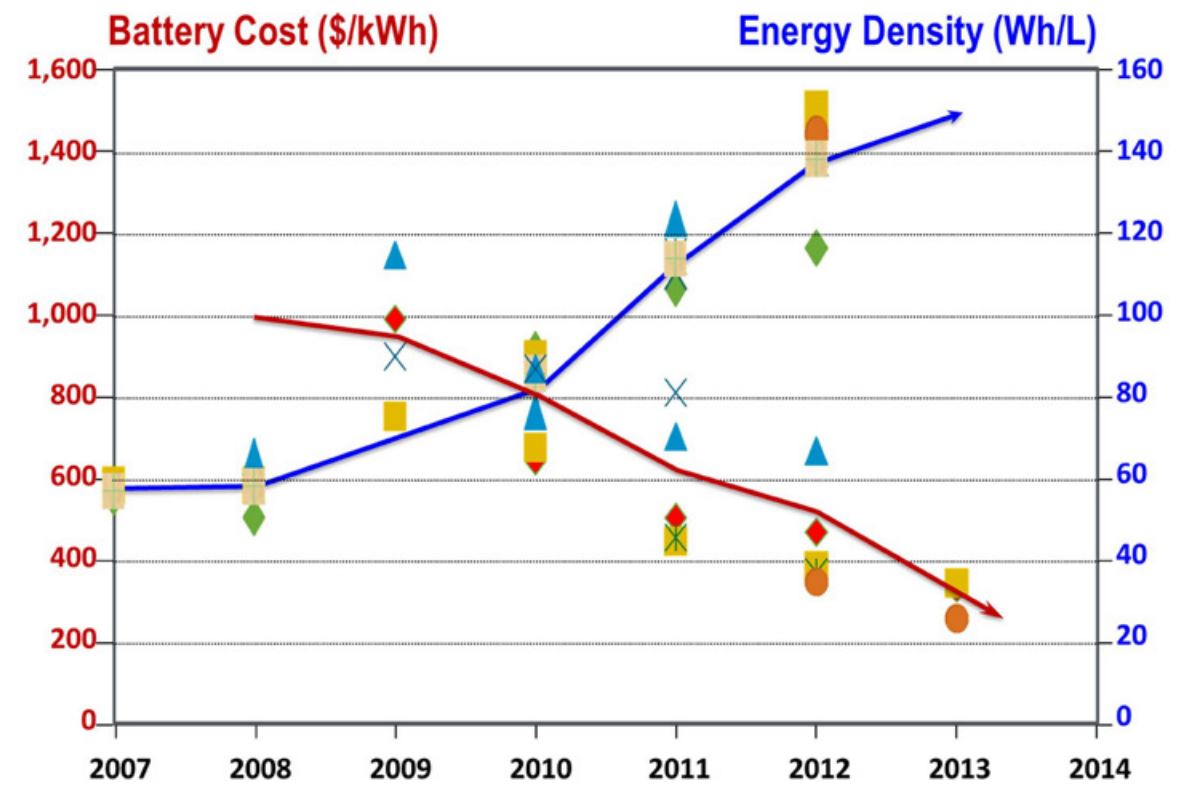
Sure, it'd be nice to have a sudden jump in battery capacity, but I think it's important to recognise that batteries have been getting better, just through incremental improvements rather than big leaps. This graph shows the change in battery density (between 2007 and 2013) and battery cost (between 2008 and 2013):
https://onclimatechangepolicydotorg.files.wordpress.com/2014...
"Source: US DoE report published as part of their EV programme."
That's possible today. I used to take my old Macbook Air off the AC power in the morning and then use it on battery till in the evening.
Interesting challenge of the terms indefinite and infinite. I read it as batteries that may die may not after every action (which would actually be indeterminate batteries :-)) rather than an infinite number of cycles.
(Now, if I could find the article I read yesterday that explaining their current status...)
Is this a "Who Killed the Electric Car" conspiracy thing? A VC thing? Or a vaporware/chemistry-is-hard thing?
For example, there was news recently about a breakthrough discovery of a -70C superconductor. The media spun it as if loss-free electricity transport and maglev trains are just around the corner. But in reality, this material (Hydrogen Sulfide) required 2 million atmospheres of pressure for superconducting at this temperature.
No conspiracy or lack of funding is behind the lack of practical applications, in this case it is just utterly unfeasible outside of a laboratory. But even if the material will never make it to the market, it's still a scientific breakthrough that will give scientists new understanding of how the processes work, and perhaps lead to other discoveries with more practical applications in 2, 20 or 200 years.
That said, I'm happy to hear the amount of research put into finding better batteries.
https://ecs.confex.com/ecs/imlb2014/webprogram/Paper33467.ht...
All batteries that you use today were (obviously) prototypes at some point in time. But you don't wait to prototype something until it's a done deal, you prototype to test. Are you really complaining that there isn't a higher success rate for all battery tests that are done?
I mean, sure, an 'indefinite life' is fine, but not if it's got more limited charge/discharge rates, energy densities, etc.
Nothing about charge/discharge rates.
Willing to wager this is just a breathless piece on carbon-air tech.
Seriously, when I think about battery tech advancement, I think about all those millions of people doing it tough in temporary communities and camps with limited power resources and inadequate infrastructure. I don't get tired of hearing about new battery tech.
”My top advice really for anyone who says they got some breakthrough battery technologies is please send us a sample cell. Don’t send us PowerPoint, ok, just send us one cell that works with all appropriate caveats, that would be great. That sorts out the nonsense and the claims that aren’t actually true. Talk is super cheap. The battery industry has to have more BS in it than any industry I’ve ever encountered, it’s insane.”
Elon Musk